Die Casting Services
"Die casting services" usually means one of two things: a factory that casts and hands the part to someone else for everything after, or a factory that carries the part all the way to finished. The second removes handling steps, quality interfaces and the arguments that live between suppliers.
This page lists what we actually do, in the order a program moves through it — engineering review, tooling, casting, machining, finishing, inspection — and says plainly what we do not do.
What do die casting services include?
Complete die casting services cover the whole path from drawing to finished part: DFM engineering review, tool design and manufacture, high-pressure casting in aluminum or zinc, CNC machining of critical features, surface finishing, inspection and documentation. Inox Die Cast provides all of them in one Dongguan factory operating since 1997 — so one organisation owns the process plan, the tooling and the quality records, instead of a program being handed between three suppliers.
At a glance
- DFM review, tooling, casting, machining, finishing and inspection in one plant
- One record from melt to shipped carton — one owner when something goes wrong
- We name what we do not do rather than claiming every process
- Production from 1,000 pieces; tooling quoted openly and owned by you
The Services, in the Order Your Part Meets Them
Engineering review (DFM). Every drawing gets one before a quote. We check walls, draft, parting line, gating, ejection and the machining split, and tell you which features will fill and eject, which need a rib or a gate change, and which are asking for more than the process gives. Changes are cheap here and expensive after steel is cut. You get reasons and alternatives, not just a price.
Tooling. Dies are designed and cut in our own tool room, in the same building as the casting cells. Cavity count, tool steel grade and tool life are quoted openly, because they drive both your unit cost and your capital outlay. The tool built for your program belongs to you, is stored under your name and is released on request.
Casting. High-pressure die casting in aluminum on cold-chamber lines and zinc on hot-chamber lines. Metal temperature, shot profile and intensification are set at the tooling trial and monitored in production; because we run both machine families, the metal recommendation follows your part rather than our equipment list.
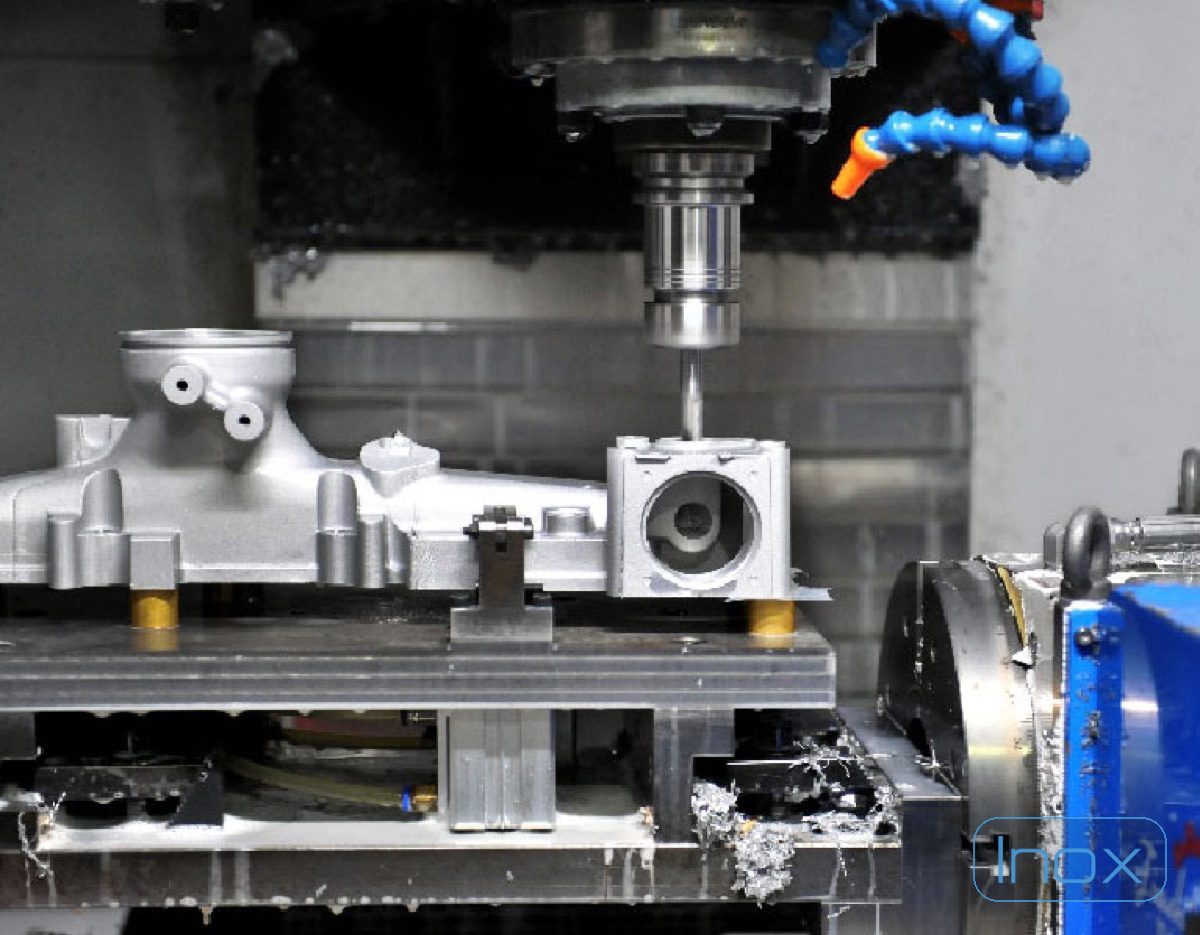
CNC machining. Castings arrive near-net, then only the features that need precision get machined — bearing bores, sealing faces, threads, datum surfaces — on lathes, 3-, 4- and 5-axis centres. Doing it in the same factory keeps the datum relationship between cast and machined features inside one quality system, so a bore and its mounting face cut in one setup stop depending on how well a second shop fixtured the part.
Surface finishing. Powder coating, painting, anodising, plating, sand blasting, vibratory polishing and conversion coatings, matched to the alloy and the service environment. Finish quality starts in the die — a plated or painted surface is only as good as the cavity beneath it — which is another reason the tool room and the finishing lines answer to the same plant. Specialist steps we subcontract are named honestly rather than hidden.
Inspection and documentation. Incoming alloy verification, in-process checks at the machine, and outgoing inspection on CMM and functional gauges against the dimensions your drawing flags critical. Material certificates, first-article reports and inspection records ship with production. Where a part carries a pressure or ingress requirement, the test is written into the control plan rather than assumed.
Packaging and logistics. Parts are packed to survive the journey they actually take, with labelling and Incoterms agreed rather than assumed — a detail that sounds trivial until a container of cosmetic castings arrives rubbed. Where a program needs sub-assembly or kitting before shipment, that is quoted as part of the routing rather than bolted on afterwards.
Why One Roof Changes the Risk Math
Every supplier boundary is a place a program can bleed. A casting made in one plant, machined in a second and finished in a third crosses three quality systems, three handling steps and three sets of commercial incentives. When a finished part is wrong, each party can point at the others — and the buyer pays for the investigation in time.
Under one roof, the same failure has one owner. A cosmetic defect traces back to the cavity that caused it. A drifting dimension goes to the tool room next door and comes back corrected in days. One record follows the part from melt to shipped carton, so first-article reports, deviation history and tool maintenance all live in the same file.
It also changes what a quote can honestly contain. Because we run the machines, we know the machine rate; because we cut the steel, we know the tool cost; because we machine and finish, we know those hours. That is how we can publish our real factory rates each quarter in an open cost index and let buyers check any quote against them — ours or a competitor's. A supplier who buys those steps from others cannot do that, because they do not own the numbers.
The honest limit: one roof is not automatically cheaper on every line. A specialist plating shop may beat an in-house line on an exotic finish, and very low volumes are usually better served by machining than by any casting service. We say so when it applies. What one roof reliably buys is fewer interfaces, faster corrections and a single point of accountability across a program's life.
There is a second-order effect worth naming. When one organisation carries the part from tool design to finished goods, the engineering review can trade cost across stages rather than optimising one in isolation. A rib added at the design stage can delete a machining setup; a gate moved can remove a finishing step; a cavity added can halve the machine cost per part at the price of a bigger tool. Those trades are invisible to a supplier who only owns one stage, because the saving lands in someone else's scope. Owning the whole route is what makes the arithmetic visible — and it is the same arithmetic our published cost index and cost calculator let you run yourself.
What We Do Not Do
We do not do investment casting, sand casting, forging or plastic injection on the die casting side, and we do not cast magnesium, steel or copper alloys. We do not quote parts we cannot run well, and we do not promise tolerances the process cannot hold.
Naming the edges matters as much as listing the services. A supplier who claims every process, every alloy and every volume has evaluated none of them — and the cost of finding that out arrives after the tool exists. When your part belongs somewhere else, the review tells you where, with reasons, and you are free to take that answer to a foundry that suits it better.
Representative application illustration — not a record of a specific customer program.
Service Scope, Stage by Stage
What each stage decides, and what helps most from your side:
| Stage | What it decides | What we need from you |
|---|---|---|
| DFM review | Whether the part casts, and how | 3D model (STEP), critical features flagged |
| Tooling | Cavity count, tool steel, tool life, unit cost | Annual volume and expected program life |
| Casting | Alloy, machine tonnage, process window | Service temperature, loads, environment |
| CNC machining | Which features are cast vs machined | Datum scheme and true tolerance requirements |
| Surface finishing | Coating system and cosmetic standard | Finish spec and where the part will live |
| Inspection | What gets measured, how often | Which dimensions actually matter, and any test requirement |
Frequently Asked Questions
Do you offer a full service from design to finished part?
Yes — DFM review, tooling, casting, CNC machining, surface finishing, inspection and documentation all run in the same Dongguan plant. What we do not offer is product design: we adapt your part to the casting process and tell you what to change and why, but the product itself remains yours. Specialist finishing steps that we subcontract are named rather than hidden.
What is the minimum order for die casting services?
Production starts at 1,000 pieces, with tooling quoted separately. Below that, machining from billet is usually the honest answer and we will say so — a steel die is a capital cost that only pays back across volume. If you are validating a design first, bridge options such as machined samples or a single-cavity tool that later scales are part of the normal flow.
How long does tooling take, and how is the program qualified?
Tooling lead time depends on part size, cavity count and complexity, and we quote it per project rather than publishing a single figure that would be wrong for most parts. The sequence is fixed: tool build, first trial, sampling, measurement against the control plan, corrections in our own tool room, re-sampling, first-article approval, then production. Corrections take days rather than weeks because the steel never leaves the building.
Can you machine and finish castings made elsewhere?
Tell us what you have in mind. Machining and finishing castings from another source is possible but rarely ideal — the value of one roof comes from the same organisation owning the casting process and the downstream operations, and taking on someone else's castings splits the accountability we are otherwise offering. If you are moving an existing program, our tooling transfer guide covers the route that usually works better.
What does a die casting service quote include?
A complete quote states the machine tonnage, the cavity count, the tool steel grade and expected tool life, the alloy, the machining and finishing operations, and the piece price at your volumes with tooling shown separately. If a quote hides those lines, that is information too. Our published cost index lets you check the arithmetic behind any of them.
Can you handle the whole program, or only individual services?
Either, though the value concentrates in the whole route. Buyers who take the complete service — review, tooling, casting, machining, finishing, inspection, packing — get one owner for the outcome and the cross-stage trades that only a supplier seeing every stage can make. Buyers who want just casting can have that too; we simply say up front that the accountability then splits at the point the parts leave us, and that the savings available from designing across stages are harder to reach.
Where to Go Next
One roof, one owner
Send the Part, Get the Whole Route Priced
Tooling, casting, machining, finishing and inspection quoted as one program by the factory that will run every stage — with the lines shown separately, not rolled into a number.
Last reviewed August 2026 · Inox Die Cast, Dongguan