ADC12 Die Casting
ADC12 is the alloy most aluminum die castings produced in Asia are actually made of, whatever the drawing says. It is A380's close relative — overlapping composition, overlapping behavior — with a slightly friendlier fluidity and, decisively, a supply chain in this region that is deep, stable and priced for volume.
This page explains what ADC12 does well, where its fluidity edge genuinely matters, and why the difference between it and A380 is more often a sourcing reality than a metallurgical one.
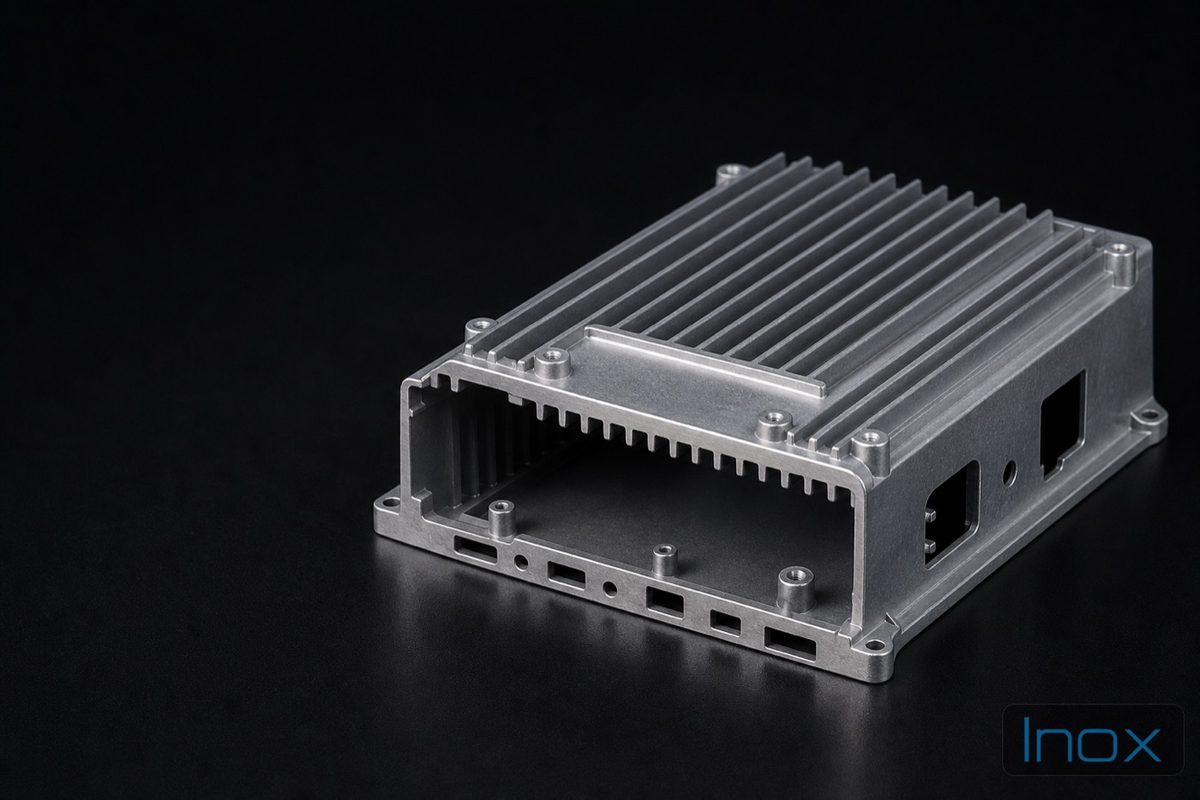
What is ADC12, and how does it differ from A380?
ADC12 is the JIS aluminum die casting alloy behind much of Asia's casting volume — a close cousin of A380, friendly to thin sections and widely available, so the practical difference from A380 is smaller than buyers often fear. It is the pragmatic default where supply chains span regions. Inox Die Cast runs ADC12-type alloys and will tell you where A380 or a high-fluidity grade suits your part better.
At a glance
- The JIS workhorse behind most of Asia's aluminum casting volume
- A close cousin of A380 — the difference matters less than buyers fear
- Friendly to thin sections at high volume
- Often the pragmatic spec when supply chains span regions
Why ADC12 Runs Asia's Volume
Availability first, and it is not a small point. An alloy your factory can source consistently, at stable price, for the ten years your program runs, is worth more than a marginal property advantage on a datasheet. ADC12's supply depth in this region is the quiet reason it dominates — and the reason a Dongguan factory quoting your part will assume it unless told otherwise.
Then fluidity. ADC12 runs a touch more willingly into thin sections than A380, which matters when your part is a consumer electronics enclosure with a fin array, or an appliance housing whose walls the industrial designer has already thinned to the edge of comfort. Across hundreds of thousands of shots, that willingness shows up as fewer short fills and a wider process window.
Everything else it shares with A380: sound general mechanical balance, good thermal conductivity that lets housings double as heat sinks, acceptable corrosion behavior under a sensible coating, and finishing routes that hold no surprises. It is a workhorse, and the honest reason to specify it is that it works and it is here.
ADC12 vs A380 — the Difference That Matters
Metallurgically the two overlap enough that for most parts either performs, and an engineer who insists on one without a stated reason is performing rather than reasoning. What separates them in practice is where the part is made. A drawing written in Detroit or Stuttgart names A380; a die casting cell in Guangdong runs ADC12. Both are correct.
Where it does matter: parts whose walls sit at the thin edge of aluminum's comfort, where ADC12's fluidity buys process margin you can feel in scrap rate. And parts sourced for a decade, where supply-chain certainty outranks a decimal place on a property table.
What we will not do is substitute quietly. The alloy in your parts is the alloy on the certificate. If your drawing specifies A380 and ADC12 is the better production answer, that is a conversation held at the review, in writing, with the reasoning stated — not a substitution discovered at incoming inspection.
Published alloy datasheets are provided on request, and material certificates accompany production shipments. We publish no property figures here: numbers your engineers design against belong in documents with their test conditions attached.
Typical ADC12 Parts
Consumer electronics enclosures and heat-sinking chassis; telecom housings with dense fin arrays; appliance components at continuous volume; power-adapter and LED fixture bodies; automotive brackets and sensor housings produced regionally. The pattern: thin-to-moderate walls, complex geometry, high annual volume, sourced in Asia.
Representative application illustration — not a record of a specific customer program.
When ADC12's Edge Is Real
Qualitative directions, confirmed per part at the engineering review:
| Situation | Does the ADC12 edge matter? | Why |
|---|---|---|
| Thin walls near aluminum's limit | Yes — meaningfully | Fluidity buys process margin and cuts short fills |
| Dense fin arrays, intricate geometry | Yes | Fill reaches the far ends more willingly |
| Ten-year program sourced in Asia | Yes — for supply, not metallurgy | Deep regional availability and stable pricing |
| General bracket or housing | Not really | A380 and ADC12 both perform; pick either |
| Pressure-tight, highly intricate parts | No — look past both | A413's fluidity outclasses either for fill-critical work |
| Small, plated, very high volume | No — wrong metal | Zinc's economics beat any aluminum grade here |
Frequently Asked Questions
Is ADC12 the same as A380?
They are close relatives with overlapping composition and largely interchangeable behavior for most parts, not identical grades. ADC12 is the Asian production standard with a slight fluidity advantage; A380 is the grade most Western drawings name. The review will tell you when the distinction genuinely affects your part rather than treating either as a badge.
My drawing says A380 — will you substitute ADC12?
Not without telling you. If ADC12 is the better production answer for your geometry and volume, that recommendation arrives at the engineering review with the reasoning written down, and the decision is yours. The alloy in your parts matches the alloy on the certificate; quiet substitution is a supplier defect, not an efficiency.
Does ADC12 finish and plate well?
Yes, on the same routes as A380 — powder coat, paint, conversion coatings and plating all have well-trodden paths. As always the casting underneath decides the outcome: coating blisters trace to gas and fill, not to the alloy. Finish-critical parts get stricter flow design at the tooling stage, and the finish spec joins the review early.
Do you publish ADC12 property tables?
Not here. Published alloy datasheets are provided on request at the engineering review, with test conditions intact, and material certificates ship with production. A property figure without its test standard is decoration; we would rather give your engineers the document they can audit.
Where to Go Next
Grade confirmation
Specify the Alloy, or Let the Part Specify It
Send the geometry, the wall thicknesses and the annual volume. If ADC12's fluidity buys you margin, you will hear why — and if A380 or A413 serves better, you will hear that instead.
Last reviewed August 2026 · Inox Die Cast, Dongguan