Die Casting for Robotics and Automation
A robot arm spends its life accelerating its own mass. Every gram in a link near the shoulder is a gram the shoulder motor must move, decelerate and hold, and the penalty compounds outward along the kinematic chain. Robotics is therefore a discipline of removing mass without removing stiffness — which is precisely the problem a die casting is shaped to solve.
We cast aluminum and zinc for joint housings, actuator bodies, gearbox casings, end-effector frames and the structural covers that hold them together, in a Dongguan factory that has been building tools since 1997.
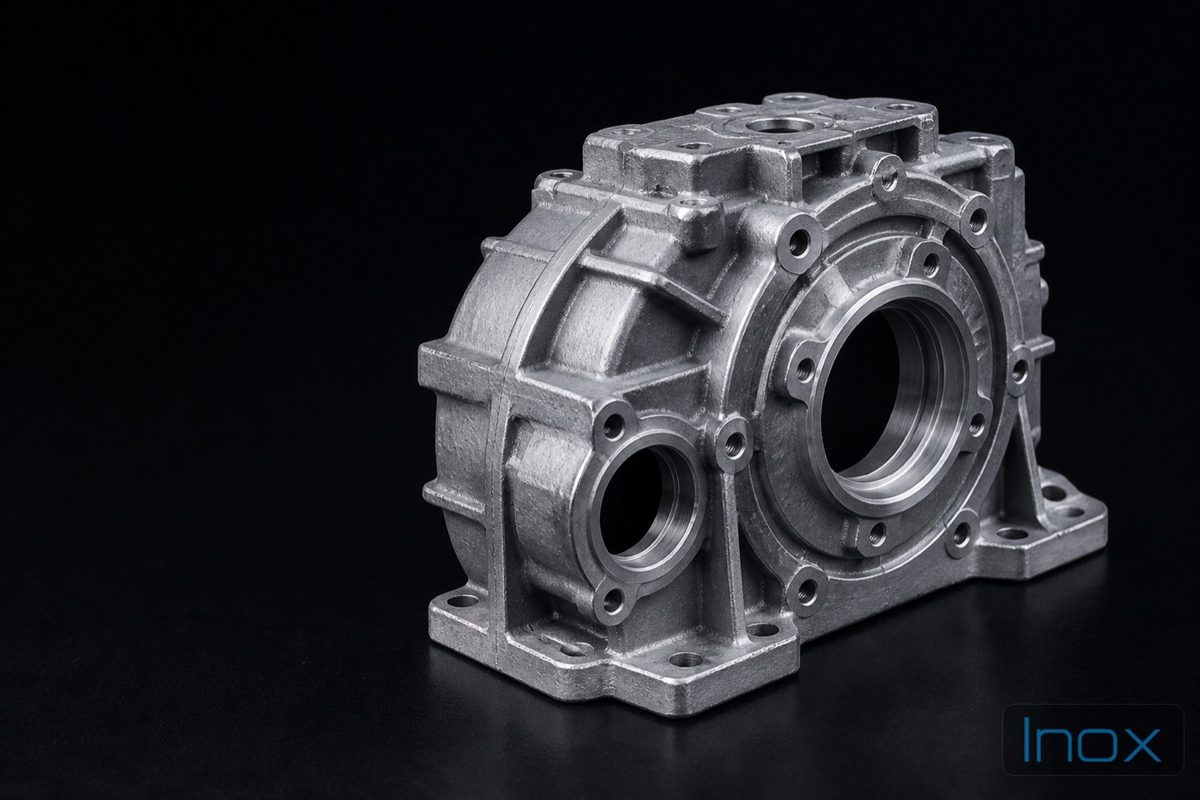
Why is die casting used for robotics and automation parts?
Robotics die casting makes joint, actuator and gearbox housings where stiffness, mass and heat all matter at once — a thin structural skin with ribs on the load path, cast fins that shed motor heat, and bores machined true after casting. Removing mass without losing stiffness is exactly what a casting does, and it matters most on the moving links a robot accelerates. Inox Die Cast casts these in aluminum and zinc and machines the critical features in-house.
At a glance
- Stiffness per gram is the whole game — ribs where the load path runs
- The housing doubles as the heat sink for sealed actuators
- Critical bores machined after casting, in the same factory
- Below the die's payback volume, machining genuinely wins — we say so
Stiffness Per Gram, Which Is the Whole Game
A machined billet housing is stiff because it is solid, and solid is heavy. A sheet-metal frame is light and flexes. A die casting sits where robotics needs it: a thin structural skin with ribs placed exactly where the load path runs, gussets under the bearing bosses, and nothing anywhere else.
The rib pattern that a casting gives you for free would take hours of milling to carve out of billet, and would still leave you paying for the metal you removed.
The second thing robotics asks of a housing is that it kill heat. Motors and drives dissipate inside sealed joints that cannot breathe, and the aluminum shell around them is the only path to ambient. Cast fins and thickened conduction paths turn the structure into the thermal solution, without the bolted-on sink that vibration would eventually loosen.
The third is precision that survives. Bearing bores, gear centres and mounting faces have to hold their relationship over a decade of cyclic load. A die casting arrives near net, gets its critical features machined in one setup on our CNC cells, and holds them because the underlying structure is rigid rather than because a fixture was clever. Zinc, where the joint is small, adds dimensional stability and lets walls go thinner than aluminum reaches.

What Robotics Programs Get Wrong at the Casting
They design the housing as if it will be machined. Uniform walls, no draft, bosses hanging in space, undercuts wherever the CAD felt natural. It can all be cast, expensively, with side actions and a tool that fights itself. Involving the caster while the topology is still soft usually removes half the tooling complexity and improves the stiffness at the same time, because ribs want to land where the die can fill them and that is often where the load wanted them anyway.
They also under-specify the transition from prototype to production. Robotics programs prototype in machined billet, which is correct, and then compare the billet part's dimensions to the cast part's and call the difference a defect. A casting is a different object with a different structure, and its critical features are made after casting, not by it. Deciding which features are cast, which are machined, and which are simply not controlled is a conversation to have before the die exists.
And they leave the volume question late. A die is a capital decision. Below the volume that amortises steel, machined billet or investment casting genuinely wins, and a caster who tells you otherwise is selling. Above it, the piece-price gap on a joint housing running through a product's life is usually the largest single cost lever the program has. We would rather tell you which side of that line you are on than build a tool you will regret.
Representative Robotics Parts
Joint and shoulder housings for collaborative and industrial arms. Actuator and servo bodies, including sealed variants with integrated cooling geometry. Harmonic and planetary gearbox casings. End-effector frames and gripper bodies, where zinc's density stops mattering and its detail starts paying. Encoder and brake covers. Base castings and structural links. Cable-management and connector housings, typically zinc where plating and fine detail are wanted.
Parts shown here are representative of what we cast for the sector rather than a customer list.
Representative application illustration — not a record of a specific customer program.
Choosing the Route for a Robotics Housing
Directional; the actual choice is settled against your loads, volume and thermal budget:
| Requirement | Aluminum die casting | Zinc die casting | Machined billet |
|---|---|---|---|
| Mass matters (distal links) | Strong fit | Poor — density penalty | Poor unless heavily pocketed |
| Small joint, fine detail | Workable | Strong fit | Workable, expensive |
| Motor or drive heat to shed | Strong fit — the shell is the sink | Weak conductivity | Workable, heavy |
| Volume below the die's payback | No | No | Strong fit |
| Volume across a product's life | Strong fit | Strong fit | Cost grows linearly |
| Bearing bores and gear centres | Machined after casting | Machined after casting | Cut directly |
| Plated or decorative surfaces | Coated | Strong fit — classic plating substrate | Anodised |
Frequently Asked Questions
Is a die cast joint housing stiff enough for a precision arm?
Stiffness comes from the section and the rib topology, not from the process, and a well-ribbed casting routinely beats a lighter machined part of the same mass. What the casting will not do is hold a bearing bore straight off the die — those features get machined, referenced to datums we agree with you, in the same cells that finish the part. The right question is not whether the casting is stiff, but whether the ribs are where your load path is. Send the load case and we will tell you.
Aluminum or zinc for robotics?
Aluminum for anything that moves or gets hot, which is most of a robot. Zinc's density is a real penalty on a link the shoulder has to accelerate, and its thermal conductivity will not help a sealed actuator. Zinc earns its place on small, static, detailed parts — gripper components, cable housings, connector shells, plated covers — where thin walls and fine detail matter more than grams. The alloy selector settles most cases in a minute.
Can you machine the castings as well?
Yes, and for robotics parts we normally do. Bearing bores, gear centres, mounting faces and threaded features are machined on our CNC cells after casting, which keeps the datum relationships inside one supplier rather than across two. That matters more than it sounds: when a bore and its mounting face are cut in one setup, their relationship stops depending on how well a second factory fixtured the part.
What volume justifies a die?
There is no universal number, and anyone offering one has not seen your part. The die is a capital cost spent once; the machined alternative charges you every part, forever. The crossing point moves with part size, cavity count, geometric difficulty and how much machining survives either route. What we can do quickly is run your part's actual numbers and tell you where the crossover falls — including when the honest answer is that your volume does not yet justify tooling.
Can you cast cooling into a sealed actuator housing?
External fins and thickened conduction paths, yes, and they are usually the whole answer. Closed internal channels cannot be die cast, because the die must open around every feature — but an open channel closed by a cover, or a drilled and plugged passage, is routine. Bring the thermal problem before the housing geometry is fixed, because the fin field, the gate and the die's opening direction are one decision and it is cheap to make once.
Where to Go Next
Robotics review
Send the Load Case With the Model
A robotics housing is a stiffness problem, a mass problem and a thermal problem wearing one skin. Give us all three and the casting gets designed once.
Last reviewed August 2026 · Inox Die Cast, Dongguan