Appliance & Telecom Die Casting
Appliances and telecommunications hardware share a demanding combination: serious volumes, cost pressure that never sleeps, and parts that are either touched by consumers daily or exposed to weather for years. Inox Die Cast has supplied this territory since 1997 — cosmetic zinc hardware at appliance volumes, and aluminum enclosures that shed heat on rooftops and towers.
This page covers what these two industries ask of castings, why they reward factory-direct supply more than most, and the part types that typically land here.
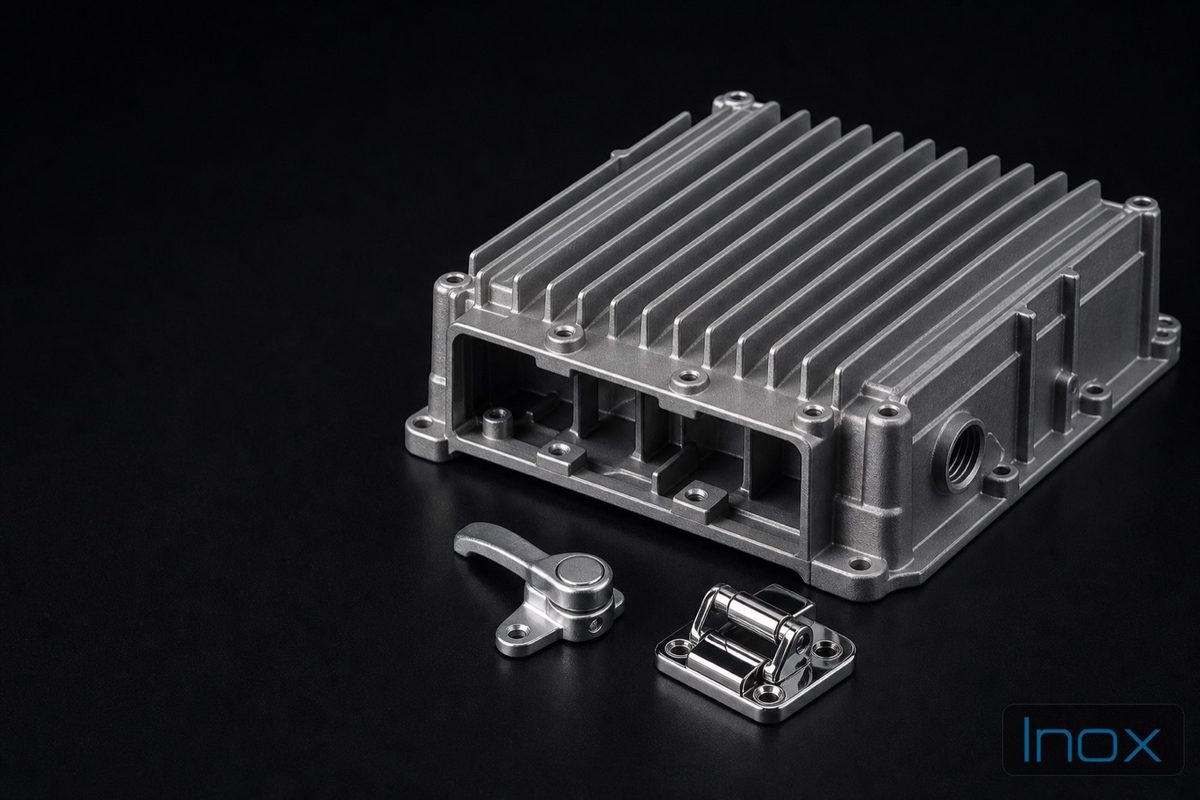
Why is die casting used for appliances and telecom?
Appliance and telecom die casting share one logic: cosmetic surfaces plus structural duty at consumer volume. Appliance trim and hardware run in plated zinc; telecom enclosures and radio housings run in aluminum that doubles as a heat sink. Inox Die Cast casts and finishes both in one factory, holding cosmetics and dimensions together across high-volume production.
At a glance
- Two industries, one casting logic: cosmetic surfaces plus structural duty at volume
- Appliance trim and hardware in plated zinc
- Telecom enclosures and heat paths in aluminum
- Consumer-volume consistency with factory-direct accountability
Two Industries, One Casting Logic
Appliance parts live with people. Handles, hinges, knobs and trim get touched thousands of times a year, so they must feel solid, look consistent across a product family, and survive kitchen chemistry — steam, grease, cleaners. Plated or coated zinc castings are the classic answer: dense feel, fine detail, surfaces made for finishing, and per-part economics that improve the more you order.
Telecom parts live outdoors with electronics inside. Radio and antenna housings, amplifier enclosures and junction bodies must shed heat without fans, seal against rain and dust, shield electromagnetic interference and sit on a tower untouched for years. That is a cast aluminum specification, with fins formed in the die, machined sealing faces and coating systems specified for real weather.
Both industries run at volumes where small per-part differences become large annual numbers — and where a broker's margin between you and the factory is pure cost with no function. Factory-direct, the unit economics and the engineering conversation both improve, and the quality trail has one owner.
Consistency at Consumer Volume
High-volume cosmetic programs are held steady by limit samples approved at first article, cavity polish maintained on schedule by the in-house tool room, and sampling inspection at rates set in the control plan. Weather-exposed telecom parts add coating verification against the named exposure conditions. Records per lot, one factory answering for them.
Multi-cavity discipline is the extra ingredient at these volumes: when four or eight cavities produce the same part, each cavity is identified, sampled and tracked individually, so a drifting cavity is caught by its number instead of contaminating the lot's statistics. Ask any high-volume casting supplier how they track cavities — the answer separates production factories from assemblers of promises.
Cost stability gets engineered too. Alloy surcharge mechanisms, energy assumptions and the triggers for any price adjustment are written into the supply terms at the start, because appliance and telecom purchasing lives on predictable unit economics. A price that moves without a written trigger is a supplier defect, and we treat it that way.
Typical Programs
Appliance: oven and refrigerator handles, hinges and latches, control knobs and bezels, burner components, mixer and small-appliance gearbox parts. Telecom: antenna and radio housings, RF shielding frames and cavities, amplifier and repeater enclosures with cast fins, pole and wall mounting hardware, connector bodies and junction boxes.
Representative application illustration — not a record of a specific customer program.
Part Type → Material and Finish Route
The usual routing decisions across these two industries:
| Part type | Usual metal | Usual finish | What decides it |
|---|---|---|---|
| Handles, knobs, trim | Zinc | Chrome or other plating | Touch feel, detail, plating brilliance |
| Hinges, latches, mechanisms | Zinc | Plating or bare | Wear resistance, fine geometry |
| Heat-exposed appliance parts | Aluminum | Powder coat or bare | Temperature tolerance |
| Outdoor telecom enclosures | Aluminum | Powder coat over pretreatment | Heat dissipation plus weather |
| RF shielding components | Zinc | Conductive finish per spec | Detail and shielding effectiveness |
Frequently Asked Questions
Can you hold cosmetic consistency across appliance product families?
Yes — that is a planning problem before it is an inspection problem. Shared color standards and limit samples across the family, cavity polish maintained centrally, and finishing in the same plant keep a handle made this year matching the hinge made last year. Bring the family's appearance standard to the review, not just one part's.
How do telecom enclosures manage heat without fans?
The casting is the thermal system: fin arrays and thick conduction paths formed in the die, machined flat interfaces where modules mount, and coating choices that respect emissivity. Send the dissipation budget with the model and the casting geometry gets shaped around it — fins cost nothing per part once they are in the tool.
What sealing can cast telecom housings achieve?
Machined sealing faces with gasket grooves cast or machined in, designed to the ingress-protection level your spec names. The casting review flags the geometry that sealing depends on — flange stiffness, fastener spacing, drainage — so the IP rating is engineered rather than tested-into late.
What volumes fit these programs?
From our standard 1,000-piece MOQ up through continuous appliance-scale production. These are the volumes where zinc's fast cycles and long tool life do their best work, and where the tooling review's cavity-count decision meaningfully changes your unit price — bring honest annual numbers and the quote optimizes around them.
Where to Go Next
Volume program review
Price the Program, Not Just the Part
Send the part family, the annual volumes and the finish standards. The proposal comes back with cavity counts, tooling plan and unit economics — the whole program picture, factory-direct.
Last reviewed August 2026 · Inox Die Cast, Dongguan