Die Casting for LED Lighting
An LED does not fail because it burns out. It fades, slowly, because its junction ran hotter than it should have for years — and the thing that decided that temperature was the aluminum around it. In lighting, the casting is not the package the product ships in. It is the product's service life, expressed as metal.
We cast aluminum luminaire bodies, high-bay housings, driver enclosures and track and downlight components, and finish them in the same factory: a 32,000 m² plant in Dongguan with its own tool room, casting since 1997.
Why is die casting used for LED lighting?
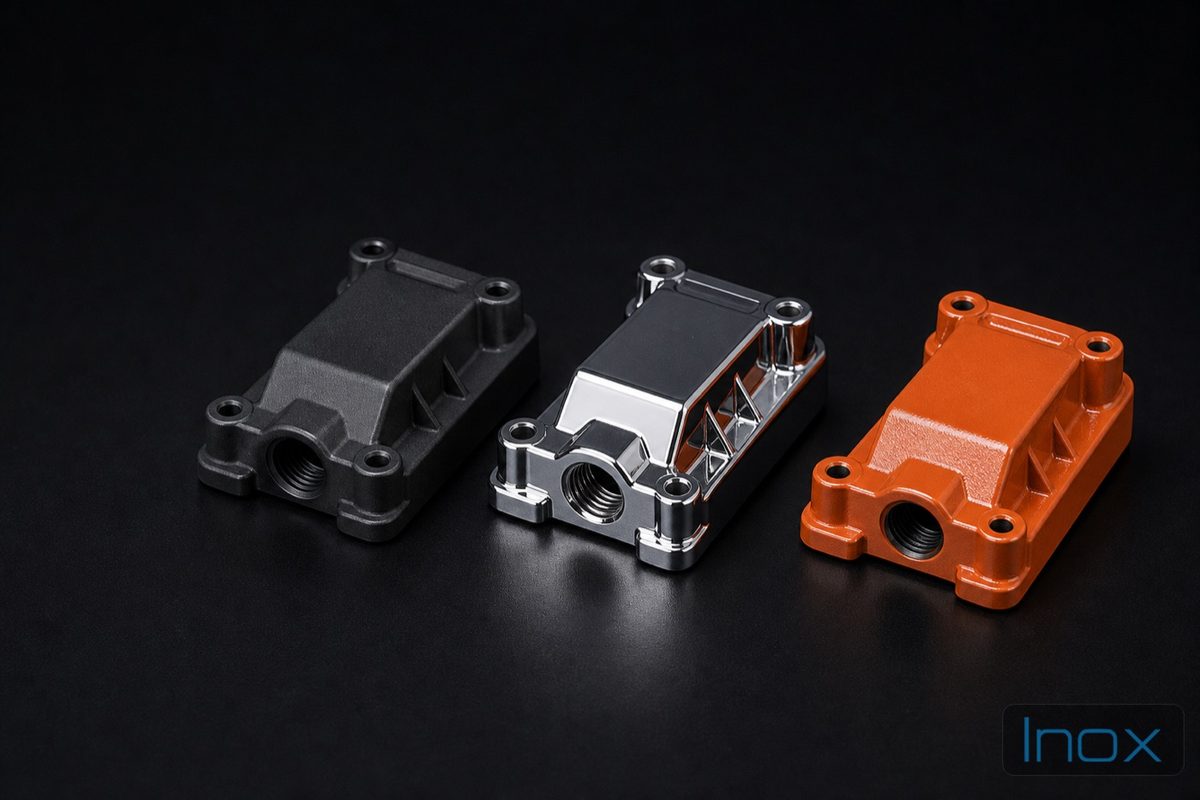
LED lighting die casting makes aluminum luminaire bodies where the heat sink, the enclosure and the ingress seal are one part — because the casting, not a bolted-on sink, decides the LED's junction temperature and therefore its service life. Fins, gasket groove and mounting bosses come out of one continuous piece of metal with no thermal interface. Inox Die Cast casts and finishes luminaire bodies in one factory for a decade of outdoor service.
At a glance
- The casting decides the LED's junction temperature — and its service life
- One part, three jobs: heat sink, enclosure, ingress seal
- Gasket grooves and parting lines must be designed together
- Cast, powder coated and finished in one factory
One Casting, Three Jobs
A luminaire body has to move heat away from the emitter and the driver, carry the optics and the mounting hardware, and keep water and dust out of both. Those are three requirements that pull a designer in three directions, and every extra part you add to satisfy one of them adds an interface that undermines another.
A bolted-on heat sink introduces a thermal resistance and a joint that will breathe as it cycles. A separate gasket channel adds a tolerance stack across parts made by different suppliers.
An aluminum die casting does all three in one piece. The fins are the enclosure. The gasket groove is cast into the same wall that carries the lens. The mounting bosses grow out of the structure rather than being fastened to it. The heat crosses one continuous piece of metal from the die-attach to the air, with no paste, no bolt tension and no assembly variation in the path.
That integration is why die casting dominates outdoor and high-power lighting once volume arrives. The alternative routes — extruded sink plus sheet housing, or machined billet — either cannot make the shape or cannot make it at the price a fixture sells for.

What Decides an LED Casting
The fin field, first, and it is a negotiation with the die rather than a free choice. Draft thickens every fin at its root, so tall dense fins swallow their own gaps. Lighting parts also tend to cool by natural convection outdoors, where pin fins and open, forgiving geometry beat the tight parallel fields that only make sense in ducted airflow. Orient the fins so draft runs along the convection direction, put the thick conduction path directly under the LED board, and feed the far fins during fill rather than starving them.
Ingress protection, second. A cast gasket groove is a cosmetic and dimensional feature at once, and it lands on a parting line more often than anyone intends. Where the seal crosses the parting line, flash becomes a leak path, and no amount of downstream inspection fixes a groove designed across a seam. That is a tooling decision made at the DFM review, and it costs nothing to make correctly and a great deal to discover during ingress testing.
Porosity, third, and it is where lighting programs get hurt. Gas trapped in the thick section between the LED board and the fin field sits exactly in the conduction path, and the same porosity opening at a machined sealing face becomes an ingress failure. Both trace back to gate position and to how the thick boss under the emitter is fed. Neither is diagnosed cheaply after the tool exists.
Finish, last and commercially first. Outdoor luminaires live in salt, ultraviolet and thermal cycling for a decade. Powder coat over a properly prepared casting is the workhorse; anodising suits some architectural work; the as-cast surface off a well-polished die needs less preparation than most buyers assume, which is where cost quietly leaves the program. All of it happens in our finishing lines rather than at a shop we hand the parts to and hope.
Representative Lighting Parts
Outdoor street and area luminaire bodies with integrated fin fields. High-bay and low-bay housings for industrial ceilings. Flood and sports lighting enclosures. Driver and gear-tray housings, often separate castings sharing the fixture's thermal path. Track heads, downlight bodies and trims. Architectural and landscape fittings where the finish is the product. Zinc appears occasionally in small decorative trims and plated accents, where detail matters and heat does not.
Parts described here are representative of the sector rather than a customer list.
Representative application illustration — not a record of a specific customer program.
Where Each Route Fits a Luminaire
Directional guidance, settled against your thermal budget, ingress class and volume:
| Requirement | Aluminum die casting | Extrusion + sheet | Machined billet |
|---|---|---|---|
| Integrated fins, gasket groove and bosses in one part | Strong fit | Not possible | Possible, expensive |
| Thermal interfaces in the path | None | One or more | None |
| Complex outdoor shapes and architectural form | Strong fit | Constrained to one profile | Strong fit, cost prohibitive |
| Ingress protection | Cast groove; parting line must be placed with care | Multiple joints to seal | Excellent, expensive |
| Tooling | Steel die, front-loaded | Cheap profile die plus fixtures | None |
| Piece price at volume | Lowest once the die amortises | Moderate, plus assembly labour | Highest |
| Best when | The fixture ships in production quantities | Low volume, simple linear fixture | Prototype or architectural one-offs |
Frequently Asked Questions
Can a cast fin field really match an extruded heat sink?
Fin for fin, no — draft bounds how tall and dense cast fins can be. Fixture for fixture, usually yes, and often better, because the cast version removes the thermal interface between sink and housing and puts fins where the air actually moves around an outdoor luminaire. Compare the assemblies from junction to ambient rather than comparing fin fields on a datasheet. On natural-convection fixtures the comparison tends to favour the casting once the interface resistance is counted honestly.
How do I get a reliable ingress seal on a casting?
Decide where the parting line runs before the gasket groove is drawn, not after. A groove that crosses the parting line will meet flash, and flash on a sealing surface is a leak path no inspection step reliably catches. Keep the seal on one side of the line, give the groove a wall thick enough to fill soundly, and treat the sealing face as a feature the tool must protect. It is free to do at the design review and expensive to fix in the tool.
What causes LED fixtures to fade early?
Junction temperature, almost always, and the casting decided it. The usual culprits are a conduction path that was thinner than the thermal model assumed, porosity in the thick section under the board, or a fin field that looked good in CAD and stalled in still air. All three are casting decisions rather than LED decisions. Bring the thermal budget to the DFM review while the housing is still soft, and the fin geometry, gate and die opening get chosen together.
Do you finish the parts as well as cast them?
Yes. Deburring, machining, powder coating and anodising run in the same factory, which means a cosmetic defect gets traced back to the cavity that caused it rather than argued between two suppliers. For architectural work where the finish is the product, that loop is worth more than any single process step. We are candid about which specialist operations we subcontract, and plating is normally one of them.
What quantity justifies tooling a luminaire body?
It depends on the fixture's size, the cavity count and how hard the fin field pushes the tool, so we do not publish a number. What we can say is that lighting is unusually favourable ground for casting, because the fixture's whole cost structure improves at once — one part instead of three, no assembly, better thermal performance and therefore a longer warranty. Send the fixture concept and the annual volume, and the crossover falls out of the arithmetic quickly.
Where to Go Next
Luminaire review
The Casting Is the Service Life
Bring the thermal budget, the ingress class and the finish you need outdoors. The fin field, the parting line and the gasket groove get decided together — which is the only way they work.
Last reviewed August 2026 · Inox Die Cast, Dongguan