Design for Manufacturing
Design for manufacturing is the engineering review that stands between your CAD model and a committed steel tool. It examines the geometry the way the process will — walls, draft, gates, ejection, machining handoffs — and returns specific findings while changes still cost a CAD session instead of a tool rework.
Our design guide teaches the rules so you can design toward them; this page describes the DFM review itself as a service — what it examines, what you receive, and how it starts. Every program here passes through it, because the review is where most of a casting's lifetime cost is actually decided.
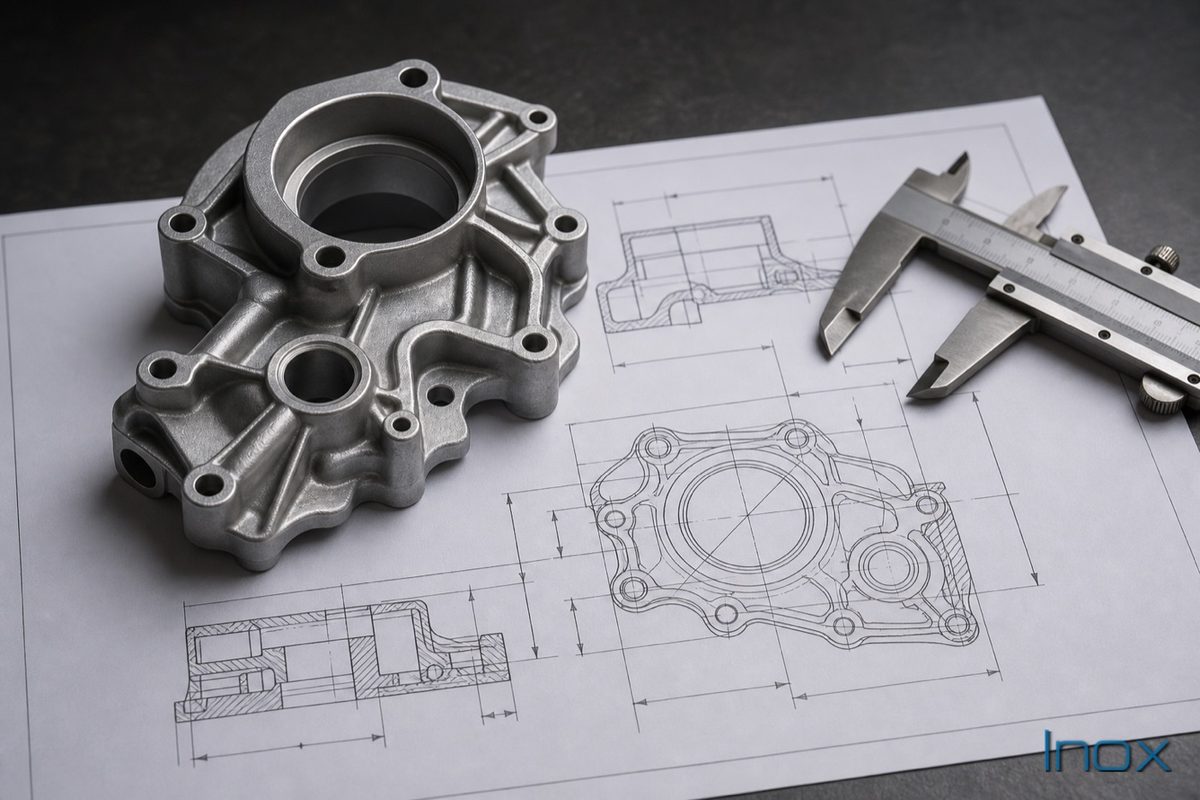
What is design for manufacturing (DFM) in die casting?
DFM in die casting is the engineering review that adapts your part to the process before steel is cut — checking walls, draft, parting line, gating, ejection and the machining split, and flagging what will not fill, eject or hold tolerance. Done early, changes are cheap; discovered after a tool exists, they are not. Inox Die Cast returns reasons and alternatives, not just a price, from engineers who stand next to the machine that runs your part.
At a glance
- Every drawing gets an engineering review before any quote
- The review examines walls, draft, parting line, gates and ejection
- You receive reasons and alternatives, not just a price
- Send the model while the design is soft — changes are cheapest then
What the Review Actually Examines
Fill and freeze: where metal enters, how it flows, where the last cold metal lands. Gate position decides surface quality and porosity placement; the review moves both away from your critical zones before the die design hardens them anywhere else. Wall-thickness uniformity gets the same treatment — every abrupt thick-to-thin junction is a future defect asking to be redesigned now.
Getting out of the die: draft on every face along the die's motion, undercuts flagged and priced or engineered away, ejector positions placed on surfaces that can accept their marks, parting line placed where its witness is tolerable. These are the decisions buyers never see until they see them on every part, forever.
The downstream handoffs: which features the die forms and which the mill finishes, whether the machining datums sit on surfaces the die controls well, how the finish specification interacts with gate and ejector placement on visible faces. Because tooling, casting, machining and finishing share this building, the review speaks for all four at once — that is the structural advantage of factory-direct DFM.
And the economics: cavity count against your honest volumes, tooling class against your program life, insert-based construction where your design is still expected to move. DFM here is not a geometry critique; it is the program's cost curve being negotiated while it is still negotiable.

What You Receive Back
A written review: findings by feature, each with the reason and the proposed resolution — accept, redesign, or move to machining. Open questions where your input decides. And when the geometry settles, the tooling proposal that the review de-risked. The findings document travels with the program file, so decisions made now remain explainable in year three. There is no charge for the review; it is how serious programs begin.
When to Send the Model
Earlier than feels natural. The highest-value reviews happen while industrial design is still fluid — when moving a boss or splitting a part is a conversation, not a change order. Models arriving 'finished' still get full value; models arriving early get compound value, because every rule the design absorbs early is a finding the review doesn't need to make late.
Representative application illustration — not a record of a specific customer program.
DFM Review Deliverables Checklist
What a complete die casting DFM review should hand back — use this to grade any supplier's review, including ours:
| Deliverable | What it contains |
|---|---|
| Feature findings | Wall, draft, radius, undercut and boss issues — each with location, reason, proposed fix |
| Gating direction | Proposed gate/overflow strategy and what it protects |
| Cast-vs-machine split | Feature-by-feature routing with datum scheme |
| Cosmetic plan | Visible zones vs gate, ejector and parting placement |
| Tooling direction | Cavity count, slide needs, insert strategy for expected changes |
| Open questions | Decisions that need your function knowledge, stated plainly |
Frequently Asked Questions
Does the DFM review cost anything?
No. The review is how programs start here, and it is where our engineering earns your tooling order honestly. What it requires from you is inputs worth reviewing: the model, the annual volume, the critical features marked, and the constraints you actually have. Thin inputs get a thin review; complete inputs get the checklist above.
How is this different from your design guide?
The guide teaches the general rules so your team designs toward the process from day one. The DFM review applies those rules — plus flow, tooling and economics judgment no guide can generalize — to your specific geometry, and returns findings in writing. Read the guide first if you like; the review meets your model wherever it stands.
Will you review a design we plan to tool elsewhere?
The review exists to start programs here, and its depth reflects that intent. If you are comparing suppliers, our supplier selection guide recommends sending the same drawing to each candidate and grading the responses — we are glad to be graded on that test, because the specificity of DFM feedback is the most honest signal a factory can give.
What if the review says die casting is the wrong process?
Then you hear that plainly, with the reasoning — sometimes the honest answer is machining at your volumes, or sheet metal for your geometry, or a two-part redesign. A review that can't say 'no' is a sales document. The factory would rather lose a mismatched program at the review stage than at the tooling trial.
Where to Go Next
Engineering first
Send the Model While Changes Are Still Cheap
The review returns written findings from the people who would build your tool. Every issue caught now is a change order that never happens later.
Last reviewed August 2026 · Inox Die Cast, Dongguan