High Pressure Die Casting
High pressure die casting (HPDC) injects molten metal into a hardened steel die at pressures that fill thin walls and fine detail in a fraction of a second, then holds that pressure while the part freezes. It is the process behind most of the aluminum and zinc components in your car, your electronics and your appliances — and it is the core process of this factory.
This page explains how HPDC actually works, where it beats the alternative metal processes, and what it asks of your part design in return.
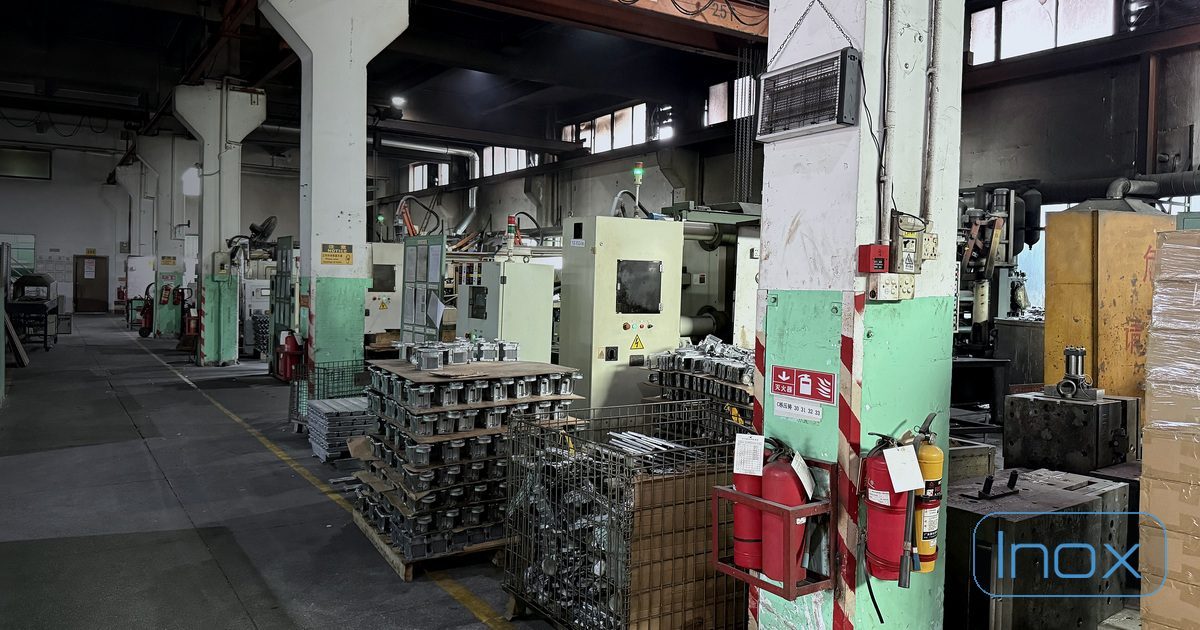
What is high pressure die casting (HPDC)?
High pressure die casting (HPDC) forces molten metal into a hardened steel die at high pressure and speed, so it fills thin walls and fine detail, solidifies in seconds, and repeats the same part for the life of the tool. It is the process behind most aluminum and zinc production castings — housings, brackets, heat sinks and enclosures — at volumes from thousands to millions. Inox Die Cast runs HPDC in Dongguan: cold chamber for aluminum, hot chamber for zinc, with tooling in-house.
At a glance
- Metal injected at speed into hardened steel dies — seconds per cycle
- Pressure fills thin walls that gravity processes freeze off in
- Hot chamber for zinc, cold chamber for aluminum, one floor
- The right answer at production volumes, not for prototypes
How the Process Works — and Why That Matters to Your Part
A shot of molten metal is forced through a gating system into the die cavity at high velocity, then intensification pressure squeezes the freezing metal against every cavity surface. That pressure is the whole story: it is why HPDC fills walls too thin for gravity processes, why surface detail comes out crisp, and why dimensional repeatability holds shot after shot for hundreds of thousands of cycles.
Speed is the second consequence. A complete cycle — inject, freeze, open, eject, close — runs in seconds to tens of seconds depending on part size. When your volumes are in the thousands and up, that cycle time is what makes cast parts cost a fraction of machined ones.
The trade is tooling: the die is a precision steel machine that must be designed, cut, heat-treated and tried out before the first sellable part exists. HPDC economics therefore follow a simple curve — tooling cost amortized over volume plus a small per-part cost. Low volumes never recover the tooling; high volumes make the tooling almost free per part. Our tooling cost guide walks the drivers in detail.
Within HPDC there are two machine families — hot chamber for zinc, cold chamber for aluminum — and the choice follows your alloy, not your preference. Both run on this floor, and the dedicated pages explain each.

Process Control in Production
HPDC rewards discipline: metal temperature, shot velocity profile, intensification pressure and die thermal balance all have set points established at tooling trial, monitored in production and recorded per the control plan. When those inputs hold steady, the output holds steady — which is why our quality conversation starts at the tooling review rather than at final inspection. First articles anchor every program, sampling holds the line across its years, and the records stay auditable. Certification scope documentation is available on request.
Where HPDC Is the Right Answer
Housings and enclosures with thin walls and cast-in bosses; brackets and structural parts at automotive volumes; heat sinks and thermal components in aluminum; small precise mechanism parts in zinc; any part currently machined from billet at quantities the mill can no longer justify. If the part is metal, complex and needed in thousands, HPDC belongs on the shortlist.
Representative application illustration — not a record of a specific customer program.
HPDC vs the Alternatives
The honest comparison buyers should run before committing to any metal process:
| Factor | High pressure die casting | Gravity / sand casting | CNC from billet |
|---|---|---|---|
| Minimum practical walls | Thinnest of the three | Thicker sections required | Any, at machining cost |
| Surface & detail as-cast | Fine detail, smooth skin | Coarser, usually machined after | Excellent but paid per part |
| Cycle time per part | Seconds | Minutes to hours | Minutes to hours |
| Tooling investment | Highest | Moderate | Fixtures only |
| Break-even volume | Thousands and up | Hundreds | Ones to hundreds |
| Dimensional repeatability | Excellent shot-to-shot | Moderate | Excellent |
Frequently Asked Questions
What alloys can be high pressure die cast?
Aluminum and zinc families carry the overwhelming majority of HPDC production, and they are what we run. Magnesium exists in the industry but is a specialist niche we do not claim. Within aluminum and zinc, specific alloy selection follows your part's strength, thermal and finishing needs — settled at the engineering review.
How many parts do I need for HPDC to make sense?
Our production starts at 1,000 pieces, and the economics strengthen from there. The real question is lifetime volume: a tool amortized over 5,000 parts adds meaningful cost per part; over 200,000 it adds almost nothing. Send honest volumes with the RFQ and the quote shows your actual curve.
Is HPDC strong enough for structural parts?
Yes, when the part is designed for the process — ribs along load paths, gates placed away from high-stress zones, and porosity controlled through flow planning. Automotive brackets and mounts have been HPDC territory for decades. What the process dislikes is heavy solid sections, which is a design conversation, not a disqualifier.
How does HPDC differ from injection molding?
They are conceptually cousins — pressure-filling a steel tool — but metal at casting temperature is a far harsher environment than plastic, so the tooling is tougher, the machines are stronger and the design rules differ in draft, walls and gating. If you are converting a plastic part to metal, our plastic-to-metal conversion guide covers exactly that path.
Where to Go Next
Process review
Find Out What HPDC Does to Your Part's Economics
Send the drawing and the lifetime volume. The review returns process fit, tooling direction and the cost curve — from the floor that runs the machines.
Last reviewed August 2026 · Inox Die Cast, Dongguan