Consumer Electronics Die Casting
Electronics enclosures ask metal to do four jobs at once: stay thin, shed heat, shield interference and look good doing it. Die casting is how metal says yes to all four — and consumer electronics is where Inox Die Cast's thin-wall casting, cosmetic finishing and fast program cadence earn their keep.
This page covers what casting solves in electronics hardware, the aluminum-or-zinc split inside this industry, and what a program looks like when the enclosure, its machining and its finish come from one factory.
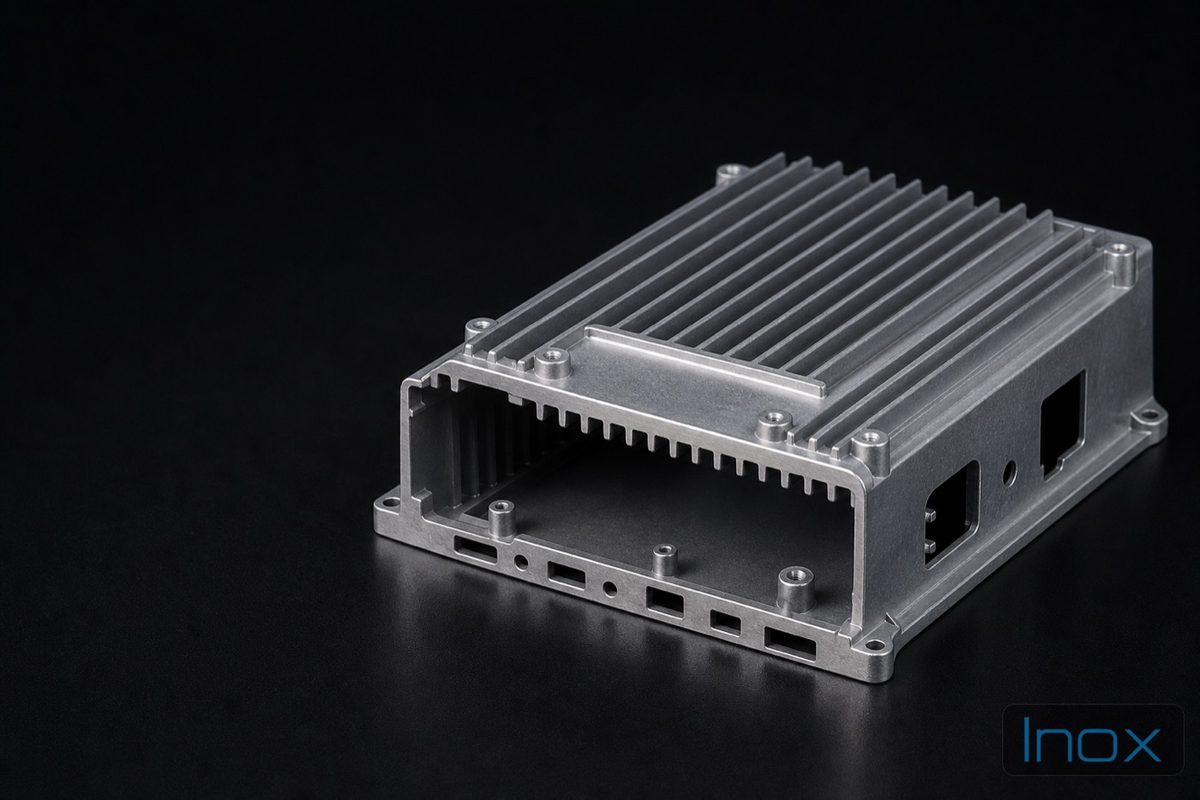
Why is die casting used for consumer electronics housings?
Consumer electronics die casting makes thin-walled aluminum and zinc housings, frames and chassis that shield, dissipate heat and look right at volume — jobs a single cast part does better than an assembly of stamped or moulded pieces. Aluminum carries the thermal load; zinc holds fine detail and plates decoratively. Inox Die Cast casts and finishes electronics enclosures in one factory, so cosmetics and dimensions are controlled together.
At a glance
- Cosmetic standards that hold at consumer volume
- Thin-walled housings, chassis and frames in aluminum and zinc
- Shielding and thermal paths cast into the structure
- Finishing controlled in the same factory as the casting
Why Electronics Hardware Goes to Metal
Heat is the first driver. As power density climbs, plastic enclosures become thermal bottlenecks; a cast aluminum chassis turns the whole housing into the heat sink, with fins and thermal towers formed in the die at zero marginal cost per part. Set-top devices, routers, LED products and power adapters converted for exactly this reason.
Shielding is the second. A metal enclosure is inherently an EMI shield — no conductive coatings on plastic, no foil tape, no late-stage EMC surprises that send the industrial designer back to the drawing board. Zinc's fine detail makes it the classic choice for connector shells and internal shielding frames.
The third driver is feel. Consumer brands discovered that mass communicates quality — a zinc volume knob, a plated zinc hinge, an aluminum speaker chassis all carry a density that plastic cannot fake. When the part is both structural and the brand's handshake with the customer, casting plus cosmetic finishing is the route.
Electronics programs also move fast and revise often. Insert-friendly tooling design and a tool room in the same building keep mid-life design changes from becoming schedule disasters — a practical advantage the RFQ stage should ask any casting supplier about.
Cosmetic Standards That Hold at Volume
Cosmetic electronics parts live or die on agreed limit samples. Appearance zones are defined on the drawing, limit samples are approved at first article, and production inspection judges against those physical anchors — so the ten-thousandth housing is graded by the same standard as the first. Finish adhesion and color checks run in the same building, with records kept per lot.
Schedule discipline matters as much as surface quality in this industry: consumer launches have dates that do not move for a casting supplier's convenience. Tooling milestones are reported as they complete, trial results arrive with measurements attached, and the ramp plan is agreed against your launch curve at the tooling review — so the factory's calendar and your marketing's calendar are the same document.
Typical Electronics Programs
Router and set-top enclosures that double as heat sinks, speaker and audio chassis, camera bodies and mounts, wearable frames and hinges in zinc, connector shells and shielding cages, power-adapter housings, and premium control surfaces — knobs, bezels, stands — where plated zinc carries the brand feel.
Representative application illustration — not a record of a specific customer program.
Electronics Enclosure Decisions: Aluminum vs Zinc vs Plastic
The three-way conversation electronics teams actually have, condensed:
| Requirement | Cast aluminum | Cast zinc | Plastic (for contrast) |
|---|---|---|---|
| Heat dissipation | The chassis is the heat sink | Good for small parts | Thermal bottleneck |
| EMI shielding | Inherent | Inherent, fine detail for cages | Needs coatings or inserts |
| Thin cosmetic detail | Good with design care | The benchmark | Excellent but feels light |
| Perceived quality / mass | Premium, light-strong | Premium, dense feel | Commodity |
| Unit cost at high volume | Moderate | Falls fastest with volume | Lowest for simple parts |
Frequently Asked Questions
How thin can electronics enclosure walls be cast?
Zinc goes thinner than aluminum, and both go thinner when flow length is short and gating is generous — which is geometry-specific. Send the model: the review answers with which walls are comfortable, which need gating support, and which would be happier split between a cast chassis and a formed cover.
Can the casting double as the product's heat sink?
That is one of the main reasons electronics programs choose aluminum casting. Fins, pedestals and thermal towers are formed in the die, and machining flattens only the interface pads the components actually touch. Bring the thermal budget to the review and the casting geometry can be shaped around it.
How do you keep cosmetic surfaces consistent across a production run?
By anchoring judgment to approved limit samples and by controlling the causes: cavity polish maintained on schedule by the in-house tool room, gate and ejector placement chosen off the visible faces at the tooling stage, and finishing handled in the same plant so parts are not commuting between vendors collecting damage.
Our design will change after launch — how bad is that?
Normal, if the tooling anticipates it. Areas flagged as likely to evolve get insert-based construction so a change swaps an insert instead of scrapping a die. Flag the moving zones in the RFQ; the tooling proposal will show how the design absorbs them and what each change would roughly cost.
Where to Go Next
Electronics program review
Bring the Thermal Budget and the Brand Standard Together
Send the model, the watts it must shed and the surfaces the customer will touch. The review returns a casting plan that treats all three as one problem — because in the die, they are.
Last reviewed August 2026 · Inox Die Cast, Dongguan