Die Casting vs CNC Machining
Die casting and CNC machining are not really rivals — they are two cost structures. Machining pays for every feature on every part, forever; casting pays once for a tool, then stamps geometry out at seconds per shot. Which structure wins depends almost entirely on one number: how many parts you will make over the program's life.
This guide locates that crossover for real programs, walks the factors beyond cost, and explains the answer most buyers actually end up with — the hybrid, where a casting carries the geometry and machining finishes only the features that need it. We run both processes, so the comparison carries no sales agenda.
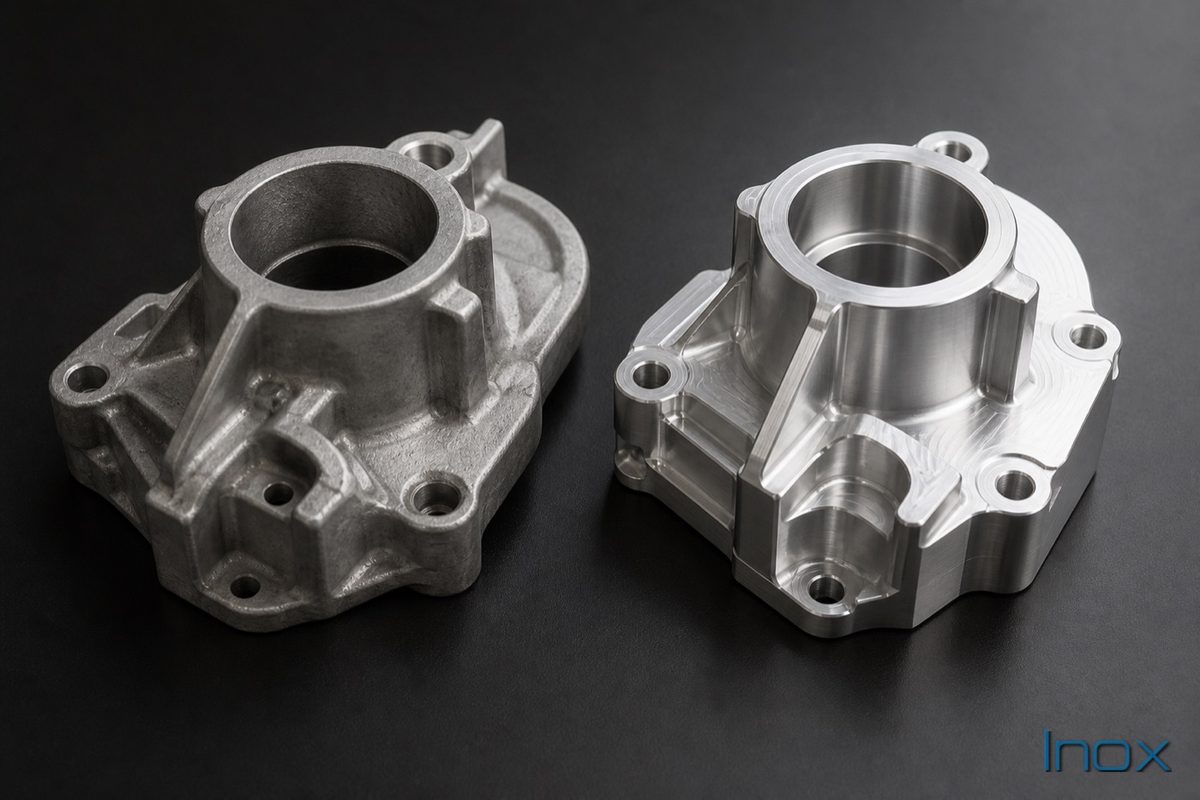
Die casting vs CNC machining — which is cheaper for my part?
CNC machining pays per part forever; die casting pays for a steel die once and then rewards you for the rest of the program. Below the crossover volume — typically the high hundreds to low thousands, shifted by part complexity — machining from billet wins. Above it, casting's piece price falls well below machining and stays there. Many parts do both: cast near-net, then machine only the critical features. Inox Die Cast will tell you which side of the crossover your part is on.
At a glance
- Machining pays per part forever; casting pays for tooling once
- The crossover typically sits in the high hundreds to low thousands
- Complex geometry shifts the crossover toward casting
- Many programs cast near net, then machine only critical features
The Cost Structures, Laid Bare
CNC from billet: zero tooling, full price per part. Every rib, pocket and bore is cutter time multiplied by your entire volume, plus the material you buy and then turn into chips — often most of the block. At ten parts this structure is unbeatable; at ten thousand it is a subscription you never stop paying.
Die casting: the tool costs real money before part one, then parts arrive at near-net geometry in seconds each. Amortize the tool across lifetime volume and add the small per-piece: at low volumes the tooling dominates painfully, at high volumes it dissolves toward zero. The crossover between the structures typically sits in the high hundreds to low thousands of lifetime parts — geometry complexity pushes it lower (complex parts are expensive to machine, cheap to cast), simple blocky parts push it higher.
Geometry votes too, beyond cost. Casting forms thin walls, complex curvature and consolidated multi-part shapes that machining reaches only at heroic cutter cost — but casting cannot match machining's tolerance on precision fits, which is precisely why the hybrid exists: cast the shape, machine the fits. Our CNC page covers how that handoff is engineered when both live in one plant.
Material chemistry is the quiet footnote: cast alloys and wrought (billet) alloys are different families with different properties, so a converted part's alloy gets re-selected, not copied. The engineering review handles that translation — it is routine, but it is not automatic.

The Conversion Case, Done Honestly
Machining-to-casting conversion is one of the classic cost projects, and done right it starts with the assembly, not the part — castings consolidate, so the best conversions merge a machined part with its neighbors and delete fasteners from the BOM. The honest checklist: lifetime volume clears the crossover; geometry is redesigned for the process (walls, draft, radii) rather than photocopied; critical fits stay machined; the alloy translation is engineered; and validation parts prove the design before the production tool commits. Skip any step and the conversion becomes the cautionary tale a competitor tells.
Who Ends Up Where
Stays machined: prototypes and pilot runs, genuine low-volume equipment, parts whose every surface is a precision fit. Converts to casting: brackets and housings that outgrew their machining bills, weldments consolidating into single castings, enclosures needing thin walls the mill prices brutally. Ends up hybrid — the biggest group: production castings with machined datums, bores, threads and sealing faces. Most 'casting vs machining' questions resolve into 'casting plus machining, correctly split'.
A note on surface finish, since it decides more conversions than buyers expect: machined surfaces carry cutter marks that cosmetic applications must polish away, while die cast surfaces arrive with a uniform as-cast skin that coatings and plating prefer. For visible consumer parts, the casting route often wins on appearance before it wins on cost — and for sealed industrial parts, the machined sealing face on a cast body takes both advantages at once.
Representative application illustration — not a record of a specific customer program.
Die Casting vs CNC: Decision Factors
Score your part down the table; the hybrid row is where most production parts land:
| Factor | Favors CNC billet | Favors die casting |
|---|---|---|
| Lifetime volume | Ones to hundreds | Thousands and up |
| Upfront investment | None — fixtures only | Tooling, amortized by volume |
| Per-part cost at scale | Flat, cutter-time bound | Falls toward material cost |
| Complex/thin geometry | Expensive cutter time | Native strength |
| Precision fits | Native strength | Machine them after casting (hybrid) |
| Part consolidation | One part at a time | Merges assemblies into one shot |
| Design changes | Reprogram and go | Tool changes cost real money |
| Material options | Wrought alloys, many | Cast aluminum/zinc families |
Frequently Asked Questions
At exactly what volume does casting win?
The honest form of the answer: divide your tooling quote by the per-part saving, and that is your break-even in parts. For a typical complex housing it lands between several hundred and a few thousand lifetime units; simple geometry pushes it higher. Send the drawing with lifetime volume and the quote shows your actual number instead of folklore.
Are machined parts stronger than castings?
Wrought billet alloys generally carry better raw mechanical properties than cast alloys — but parts are not raw properties. A casting redesigned with ribs along its load paths frequently outperforms the machined original at a fraction of the mass and cost. Strength is a design outcome; the review engineers it rather than assuming it.
Our part is machined today — what does a conversion review need?
The current drawing, the neighbors it bolts to (consolidation is where conversions shine), lifetime volume, and which surfaces are true precision fits. Back comes the crossover math, the redesign direction and the hybrid split — enough to decide with numbers. The industrial equipment page shows where these conversions typically come from.
Why not just ask a machine shop and a caster separately?
You can — and each will honestly favor its own process, because that is what each sells. A factory running both under one roof gets paid either way, which is the closest thing to an unbiased referee this question has. The quote can show both routes side by side; several of ours have recommended staying machined.
What happens to lead time when a part converts?
It splits into two phases. Tooling adds weeks up front — the timeline is stated in the quotation — and machined bridge parts can carry your schedule through it. After launch, per-unit lead time usually improves: casting cells produce in hours what machining queues produce in days, and call-off scheduling stabilizes around the running program. Conversions rarely fail on lead time; they fail on skipped validation, which is a choice.
How do engineering changes compare between the two routes?
Machining absorbs changes by reprogramming — cheap and fast, its genuine advantage while a design is still fluid. Castings pay for changes in tool modifications, which is why conversion timing matters: convert after the design settles, or plan insert-based tooling for the zones still expected to move. The DFM review asks that question explicitly, because converting a moving design is how tooling budgets get eaten twice.
Where to Go Next
Crossover math
Stop Guessing Where the Crossover Sits
Send the machined part's drawing and its lifetime volume. The review returns break-even math, the hybrid split and a recommendation from a factory that profits either way — which is why you can trust it.
Last reviewed August 2026 · Inox Die Cast, Dongguan