Industrial Equipment Die Casting
Industrial equipment is where parts earn their keep the hard way: continuous duty, vibration, weather, careless handling and a service life measured in years. Inox Die Cast supplies die cast housings, frames, gearbox components and enclosures for machine builders and equipment OEMs who need castings specified for that reality — not for a spec sheet's best day.
This page covers what industrial service does to castings, which parts typically convert from fabrications, and how factory-direct supply changes the long-program economics machine builders care about.
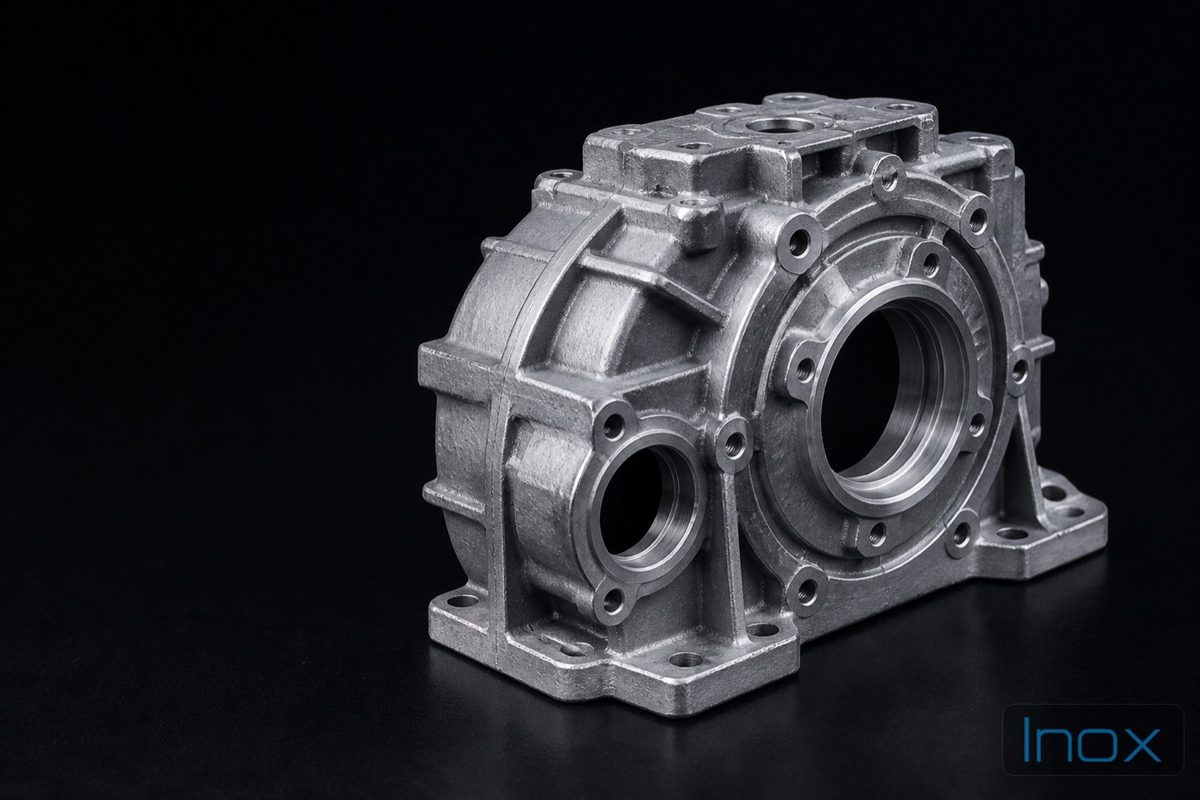
Why is die casting used for industrial equipment?
Industrial equipment die casting makes housings, casings, brackets and gearbox and pump bodies built for duty — parts that must hold their dimensions across years of service, at volume that machining cannot match at scale. Aluminum and zinc both run under one quality system. Inox Die Cast casts, machines and finishes in-house, so consistency holds over program life rather than just at first-article.
At a glance
- Housings, casings and brackets built for industrial duty
- Consistency across years of program life, not just first articles
- Aluminum and zinc under one quality system
- Volume economics machining cannot match at scale
What Industrial Duty Actually Demands
Stiffness under vibration comes first. Motors, gearboxes and pumps shake their housings millions of cycles per year, and bolted sheet-metal fabrications loosen, buzz and crack at welds. A ribbed casting puts material exactly where the load paths run, casts the mounting bosses integral, and holds bearing bores in stable alignment — which is why gearbox and drive housings were among die casting's first industrial conquests.
Environment resistance comes second. Factory floors mean coolant mist, washdowns and temperature swings; outdoor equipment adds rain, UV and salt. The casting-plus-coating system is specified as one decision — aluminum alloys with sound corrosion behavior under powder-coat or ED systems chosen for the actual exposure, with drainage and crevice geometry designed in at the die.
Long-program economics come third. Industrial platforms live for a decade, and their parts need suppliers who keep the tool healthy for that long. In-house tooling with scheduled maintenance and a documented history is the difference between year-eight castings that match year-one and a mid-life supplier scramble.
Consistency Over Program Life
Long programs are held together by records: the control plan from the tooling review, first-article results as the anchor, sampling data across the years, and the tool-maintenance log that explains — and prevents — dimensional drift. When your platform ships for a decade, the casting record reads like a service history, kept by the factory that made both the tool and every part.
Spare-part continuity is the quiet test of an industrial supplier. Machines in the field need replacement castings years after the platform stopped shipping new units, in quantities too small to interest a factory that never knew your program. Because the tool and its records stay here, aftermarket batches run against the same die and the same control plan — a promise worth writing into the supply agreement, and one we expect you to ask about.
Typical Industrial Programs
Gearbox and drive housings, motor end bells and fan guards, pump bodies and valve components, control and junction enclosures, sensor and actuator housings, robot-arm structural elements, conveyor and material-handling brackets, and power-tool housings that take abuse as a job description.
Representative application illustration — not a record of a specific customer program.
Fabrication vs Casting: The Industrial Conversion Math
Machine builders usually arrive holding a welded or machined assembly. This is the comparison that decides:
| Consideration | Welded / machined fabrication | Die casting |
|---|---|---|
| Upfront cost | Low — no tooling | Tooling investment first |
| Per-part cost at volume | Flat, labor-heavy | Falls hard as volume climbs |
| Vibration endurance | Welds and fasteners are the weak points | Integral ribs and bosses; no joints to loosen |
| Part count & assembly | Many pieces, many operations | Consolidated into one part |
| Consistency across years | Depends on welder and fixture | The die repeats itself |
| Break-even signal | Under ~1,000/yr, usually stays fabricated | From ~1,000/yr, conversion review is worth it |
Frequently Asked Questions
When does converting a weldment to a casting pay off?
As a rule of thumb, from around a thousand parts per year the conversion review is worth running — tooling amortizes across enough parts while assembly labor and weld inspection disappear from every unit. Send the fabrication drawing with your annual volume and the quote shows the actual crossover for your assembly.
Can castings handle continuous vibration next to motors and gearboxes?
That is their natural habitat, provided the design puts ribs along the load paths and keeps gates away from high-stress zones — decisions made at the tooling review. Unlike welded assemblies there are no joints to loosen or weld toes to crack; fatigue behavior is engineered into one homogeneous part.
What coatings survive factory and outdoor environments?
Powder coating over a proper pretreatment carries most industrial duty; ED coating adds a uniform base where recesses and cavities need protection too. The specification follows your named environment — coolant mist, washdown chemistry, outdoor exposure — and the finishing review pairs it with acceptance criteria you can audit against.
Our platform will run for ten years. What happens to the tool?
It lives in the plant that built it, on a maintenance schedule driven by shot count, with its history documented. Expected tool life against your volumes is stated at quotation, and when a tool eventually needs cavity restoration or replacement, that conversation happens from records, years before it becomes a supply emergency.
Where to Go Next
Industrial program review
Bring the Weldment. Leave With the Conversion Math.
Send the assembly drawing, the annual volume and the environment it lives in. The review returns the casting proposal with the crossover economics spelled out.
Last reviewed August 2026 · Inox Die Cast, Dongguan