How Much Does a Die Cast Tool Cost?
Every buyer asks, and every honest answer starts the same way: it depends — but on knowable things. A die cast tool is a precision steel machine, and its price is assembled from a short list of drivers you can read directly off your part: size, cavity count, side actions, cosmetic demands, expected life and the alloy it will fight.
This guide will not print a price table, because a number without your geometry misleads in both directions. What it will do is make you the buyer who reads a tooling quote line by line, asks the questions that expose padding, and understands exactly why two quotes for 'the same part' can differ by half.
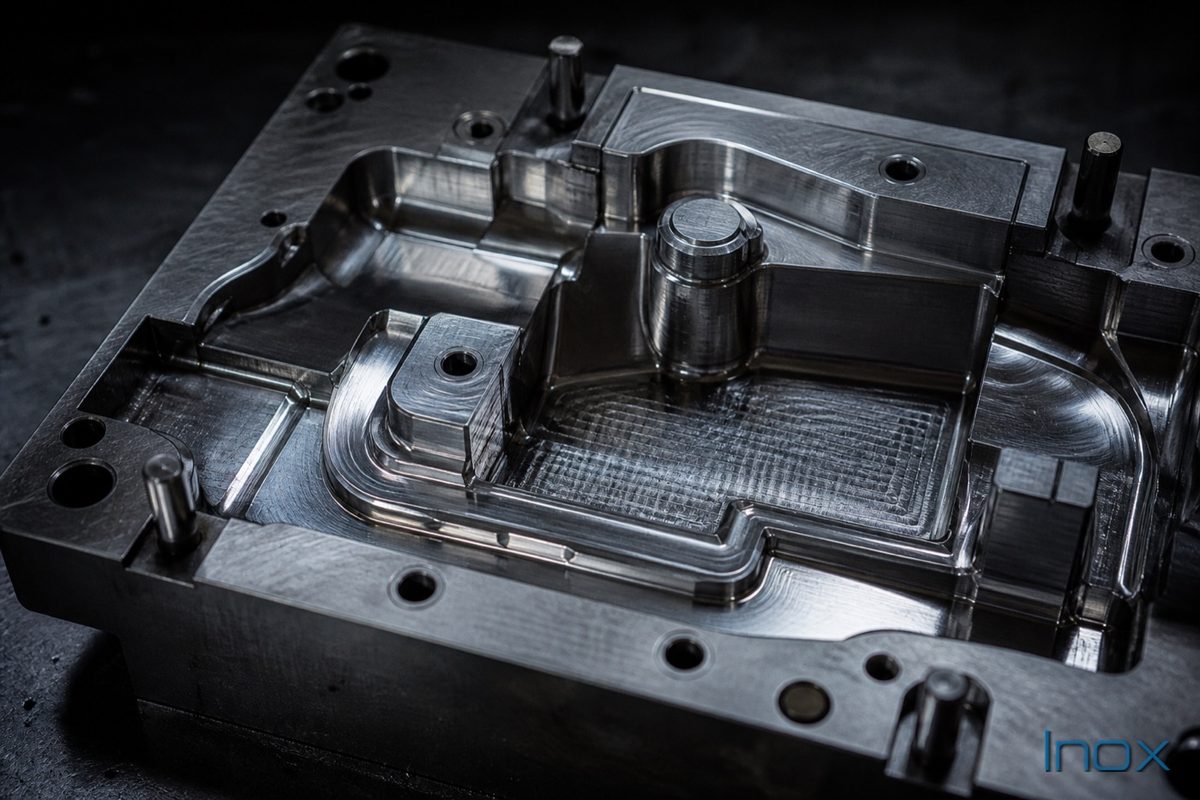
How much does a die casting tool cost, and what drives it?
Die casting tooling cost is driven by part size, geometric complexity, cavity count, the number of slides and side actions, required tool life, and surface finish — roughly in that order of impact. There is no universal price: a small single-cavity zinc tool and a large multi-cavity aluminum tool differ by an order of magnitude. What matters is a complete quote stating cavity count, tool life and ownership. Inox Die Cast quotes tooling transparently, and the tool is yours.
At a glance
- Seven cost drivers, ranked by how hard they punch
- What a complete tooling quote states — and what a vague one hides
- How tooling cost becomes unit cost through amortisation
- No universal price exists; the drivers tell you where yours lands
The Seven Drivers, In Order of Punch
Part size sets the floor: a bigger part means a bigger die block, more steel to buy, more steel to cut, and a bigger machine to run in — costs that scale before a single feature exists. Cavity count multiplies from there: a four-cavity tool is not four times a single-cavity price (shared die base, one design effort), but it is far from free, and its payback depends entirely on your honest volumes.
Side actions come third: every undercut that survives the DFM review buys a slide or lifter — moving steel with its own machining, fitting and lifetime maintenance. This is why the review pushes so hard on undercuts; each one engineered away is real money deleted from the quote. Cosmetic class is fourth: a plated appliance handle needs cavity polish and gate placement discipline that a hidden bracket never pays for.
Then the endurance drivers: tool steel and heat treatment scale with expected life and with alloy — aluminum's temperature and abrasiveness demand more from steel than zinc does, which is part of why zinc programs amortize so gently. Engineering-change provisioning is sixth: insert-based construction where your design is still moving costs a little now and saves rework repeatedly later. Seventh is the trial: a tool is not done when it is cut, but when sampled parts measure to drawing — sampling, correction loops and first-article work belong in the price, and a quote that omits them has just moved them into your surprise budget.
Read any tooling quote against these seven and the mystery evaporates. Better: send the same drawing to every candidate and compare which drivers each quote itemizes versus buries. The itemization habit is itself a supplier signal — our supplier selection guide makes it a scoring row.

What a Complete Tooling Quote States
Ours itemizes: cavity count and layout, slide/lifter count, steel and heat treatment, cosmetic class, expected life against your stated volumes, what the trial includes, the engineering-change mechanism, and the ownership terms — who owns the die, where it lives, what maintenance is included. Tooling disputes are the classic sourcing failure in this industry, and every one traces to a term that lived in somebody's memory instead of the quotation.
How Tooling Cost Becomes Unit Cost
The number that actually matters is tooling cost divided by lifetime parts, added to the per-piece price. A tool amortized over five thousand parts may dominate unit economics; the same tool over five hundred thousand parts nearly vanishes. This is why the RFQ asks for honest lifetime volume, why zinc's long tool life rewrites high-volume math, and why staged tooling exists for programs whose demand is still a guess — the prototyping page covers that bridge.
Representative application illustration — not a record of a specific customer program.
Tooling Cost Drivers and What Moves Them
Use this to interrogate any tooling quote — including ours:
| Driver | What increases it | What you can do about it |
|---|---|---|
| Die size | Part envelope, projected area | Compact the design; question oversize flanges |
| Cavity count | High annual volume | Match to honest volumes, not hopes |
| Slides & lifters | Undercuts, side holes, side features | Redesign at DFM; each one removed is real money |
| Cosmetic class | Visible/plated surfaces | Mark true cosmetic zones only |
| Steel & heat treatment | Aluminum alloy, long life targets | State realistic program life |
| Change provisioning | Evolving design | Flag moving zones for insert construction |
| Trial & first article | Tight criticals, cosmetic standards | Mark criticals with reasons — pay for the right proof |
Frequently Asked Questions
Why do tooling quotes for the same part vary so much?
Because they rarely price the same tool: different cavity counts, steel grades, cosmetic assumptions, trial scopes and ownership terms hide inside one headline number. Normalize the seven drivers before comparing — and treat the vaguest quote as the most expensive one, because its gaps become your change orders.
Who owns the tool, and can it move?
In our quotes: ownership terms are written in — typically you own the tool you paid for while it runs and is maintained in our plant, with its design files and maintenance log part of what ownership means. Transfers in and out are handled case by case with inspection first; we have received transferred tools and will assess honestly whether yours is worth moving.
How long does a die cast tool last?
Zinc tooling routinely outlives aluminum tooling several times over — lower casting temperature, gentler delivery. Beyond alloy, life follows steel selection, heat treatment and maintenance discipline. Expected life is stated in the quotation against your volumes, and the maintenance log is how the promise stays auditable across the program's years.
Can tooling cost be spread into the piece price?
Commercial structures vary — separate tooling invoice, amortization into unit price, or hybrid — and each moves risk differently for both sides. State your preference in the RFQ and the quote responds with terms in writing. What we avoid is the structure where 'free tooling' hides in a piece price you cannot audit.
What information gets me an accurate tooling quote fastest?
The model (STEP), the drawing with criticals and cosmetic zones marked, honest annual and lifetime volume, alloy direction, finish spec, and where the design might still change. With those, the seven drivers resolve into a real number in the first pass instead of the third.
Is cheaper tooling from a broker ever the better deal?
Occasionally on price, rarely on program. A broker's tooling number hides who actually cut the steel, who maintains it, and where your design files live — three questions that come due the first time the tool needs correction or the relationship needs an exit. Tooling is a multi-year marriage with a physical asset; buy it from whoever will be maintaining it, and make them put the maintenance terms in the quote.
What does tool maintenance cost over a program's life?
Scheduled maintenance — cleaning, minor cavity restoration, component replacement on shot count — is included in how we run programs, with the log open to audit. What costs extra, and is quoted when it arises: major cavity rework from engineering changes or end-of-life restoration. The distinction is stated in the quotation so year-three surprises are structurally impossible.
Where to Go Next
Tooling economics
Get a Tooling Quote You Can Actually Audit
Send the drawing and honest volumes. The quote comes back itemized against the seven drivers — with ownership, life and trial scope in writing.
Last reviewed August 2026 · Inox Die Cast, Dongguan