A380 Aluminum Die Casting
A380 is what a die casting engineer reaches for when nothing about the part argues for anything else — and that is a compliment, not a shrug. It fills complex geometry reliably, balances mechanical properties without excelling at any one of them, conducts heat, resists corrosion acceptably and takes finishing without complaint. Most aluminum castings in the world are some relative of A380 for exactly these reasons.
This page explains what A380 is good at, the specific situations where it stops being the right answer, and how the grade gets confirmed against your part rather than assumed.
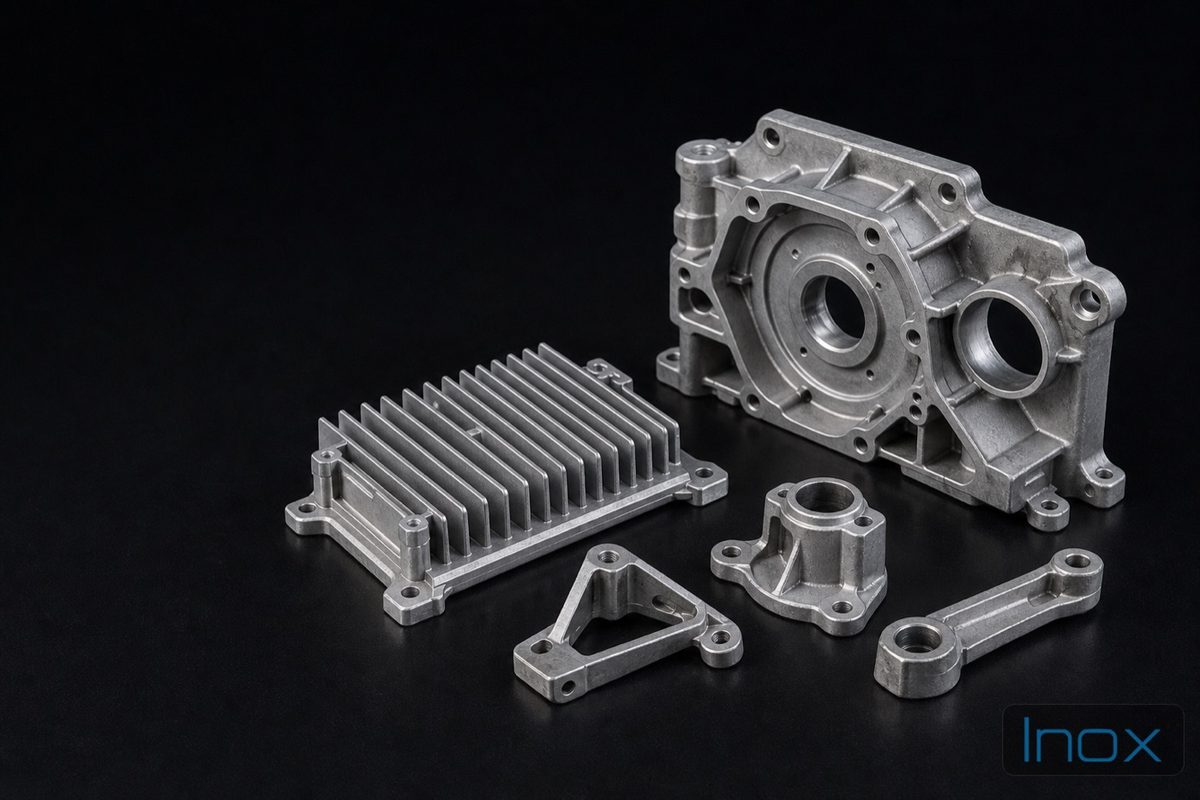
What is A380 aluminum, and when is it used in die casting?
A380 is the all-round default aluminum die casting alloy — a workable balance of castability, strength and machinability that fills complex geometry and suits most housings, brackets and covers. It is where an aluminum program starts unless a specific demand (high fluidity, pressure-tightness, corrosion or conductivity) points elsewhere. Inox Die Cast runs A380-type alloys on its cold-chamber lines, confirmed against your part at the engineering review.
At a glance
- The all-round default for aluminum housings and brackets
- Castability, strength and machinability in a workable balance
- Where it stops: high-fluidity, corrosion or conductivity demands
- Typical parts: enclosures, brackets, telecom and automotive housings
Why A380 Became the Default
Balance, mostly. A380 asks for no heroics from the process and gives no dramatic weaknesses back. It runs stable in cold-chamber machines, fills the ribs and bosses of a well-designed housing, holds dimensions across a shift, and does not fight the trim die. A supplier can quote it confidently because its behavior is boring in the way production engineers pray for.
Its thermal conductivity is good enough that housings routinely double as heat sinks, which is why power electronics and motor enclosures land here so often. Its corrosion behavior, paired with a sensible coating, survives the environments most industrial and automotive parts actually live in.
And it finishes. Powder coat, paint, conversion coatings and plating all have well-trodden routes on A380, so the finish specification rarely surprises anybody at the coating line — provided, as always, that the casting underneath was gated and vented properly. No alloy rescues a fill problem; A380 simply gives you fewer of them to begin with.
Where A380 Stops Being the Answer
Three situations move the review off A380. First, geometry that punishes fill — intricate detail, very thin flowing sections, or a pressure-tightness requirement a leak test will interrogate. There, A413's superior fluidity earns its place at the cost of some strength.
Second, high-volume programs sourced regionally, where ADC12's slightly friendlier fluidity and deep Asian supply chain make it the practical default rather than A380's nominal one. The two are close cousins; the difference is often supply reality more than metallurgy.
Third — and this is the one buyers miss — a part that should not be aluminum at all. If the geometry is small, intricate, plated and high-volume, no aluminum grade will beat zinc's economics. A380 is the right answer to the aluminum question, not proof that aluminum was the right question. The alloy selector settles that in a minute.
Published alloy datasheets are provided on request, and material certificates accompany production shipments. We publish no property figures here: the numbers your engineers design against belong in documents with their test conditions attached, not in website tables.
Typical A380 Parts
Automotive brackets, mounts and sensor housings; motor and gearbox housings; power-electronics and telecom enclosures with cast-in cooling fins; industrial equipment frames and pump bodies; appliance components living near heat. The pattern: structural or thermal duty, moderate-to-large size, geometry that a competent DFM review has already made castable.
Representative application illustration — not a record of a specific customer program.
A380 Against Its Neighbours
Qualitative directions — the grade is confirmed per part at the engineering review:
| Compared with | A380 gives you | The other gives you | Choose the other when |
|---|---|---|---|
| ADC12-type | The Western reference grade most drawings name | Slightly friendlier fluidity, deeper regional supply | High volume cast in Asia, thin sections |
| A413-type | Better all-round mechanical balance | Outstanding fluidity for intricate, pressure-tight parts | Fill is the dominant risk, not load |
| Zinc (Zamak family) | Light weight, heat handling, larger parts | Thinner walls, finer detail, longer tool life | The part is small, intricate, plated and high-volume |
Frequently Asked Questions
Is A380 the same as ADC12?
Not identical, but close relatives with overlapping composition and behavior. ADC12 is the grade that dominates Asian production and carries a slight fluidity edge; A380 is the reference most Western drawings name. For the majority of parts either performs, and the review will tell you when the difference genuinely matters for your geometry rather than treating it as ceremony.
Can A380 be pressure-tight?
Often, with a fill designed for it — gate and overflow placement putting the last, coldest metal outside your sealed zone, and verification by leak test where the drawing requires. But when pressure-tightness is the defining requirement of the part, A413's fluidity gives the process more margin. Mark the sealed zones on the drawing and the review routes the alloy accordingly.
How does A380 behave under powder coat?
Well, provided the casting is sound. The classic failure is a blister appearing at cure temperature — subsurface gas expanding — and that traces to fill and venting, not to the coating or the alloy. Finish-critical parts therefore get stricter flow design at the tooling stage, which is one more reason the finish specification joins the review early.
Do you publish A380 mechanical properties?
Not on this page. Published alloy datasheets are provided on request during the engineering review, with test methods and conditions intact, and material certificates ship with production. A tensile figure stripped of its test standard is decoration; we would rather hand you the document your engineers can actually audit.
Where to Go Next
Default, verified
A380 Is a Good Guess. The Review Makes It a Decision.
Send the geometry, the loads, the sealed zones and the finish. If A380 is right, you will hear why. If it is not, you will hear that instead.
Last reviewed August 2026 · Inox Die Cast, Dongguan