Aluminum Alloy Selection
Once your part has chosen aluminum, one question remains: which alloy family. In production die casting the answer almost always lands in one of three — A380, ADC12 or A413 — and each has a distinct personality. Picking well costs nothing; picking by default costs quietly, forever.
This page explains what each family is good at, what it gives up in exchange, and how the specific grade is settled against your geometry rather than promised on a website.
How do you choose an aluminum die casting alloy?
Aluminum die casting alloy selection comes down to three families: A380-type is the all-round default; ADC12-type is its Asian-volume cousin, friendly to thin walls; A413-type trades some strength for outstanding fluidity and pressure-tightness. Start at the default and move only against a measured need — fluidity, pressure-tightness, corrosion or conductivity. Inox Die Cast confirms the grade against your part's function at the engineering review, not by datasheet shopping.
At a glance
- Three families, honestly characterised: A380-type, ADC12-type, A413-type
- The default earns its place — upgrade only against a measured requirement
- Grade confirmed at the engineering review, not by datasheet shopping
- Certificates ship with production; datasheets on request
The Three Families, Honestly Characterised
A380-type is the default, and defaults become defaults for reasons. It fills complex geometry reliably, carries a balanced set of mechanical properties, conducts heat well and takes finishing without drama. If nothing about your part is unusual, the review will most likely start here — and stay here.
ADC12-type is A380's close relative, dominant in Asian production. Its fluidity is a touch friendlier to thin sections, and its supply chain in this region is deep and stable, which matters when your program runs for years. High-volume consumer and appliance parts sourced from China land here so often that it is effectively the regional default.
A413-type trades some mechanical strength for outstanding fluidity. When the casting must fill intricate detail, thin flowing sections, or reach pressure-tightness that a leak test will interrogate, A413's willingness to run into every corner earns its place. It is the specialist you call when geometry, not load, is the hard part.
What none of these three do is rescue a design. Alloy selection tunes a good casting; it cannot save a part with thick solid bosses and no draft. The DFM review comes first, and the alloy conversation happens inside it.
How the Grade Is Actually Confirmed
The review reads your part for four signals: what loads the metal carries, how hot it runs, how thin and intricate the geometry gets, and what the surface must do afterward. Those four narrow the family. Melt practice, gating and thermal design then get tuned to the choice, because an alloy is a process decision as much as a chemistry one — the same grade behaves differently through a well-gated die than a poorly gated one.
Published alloy datasheets are provided on request, and material certificates accompany production shipments. We publish no invented property figures here: numbers that matter to your engineering belong in documents you can audit, not in marketing copy.
Where Each One Tends to Land
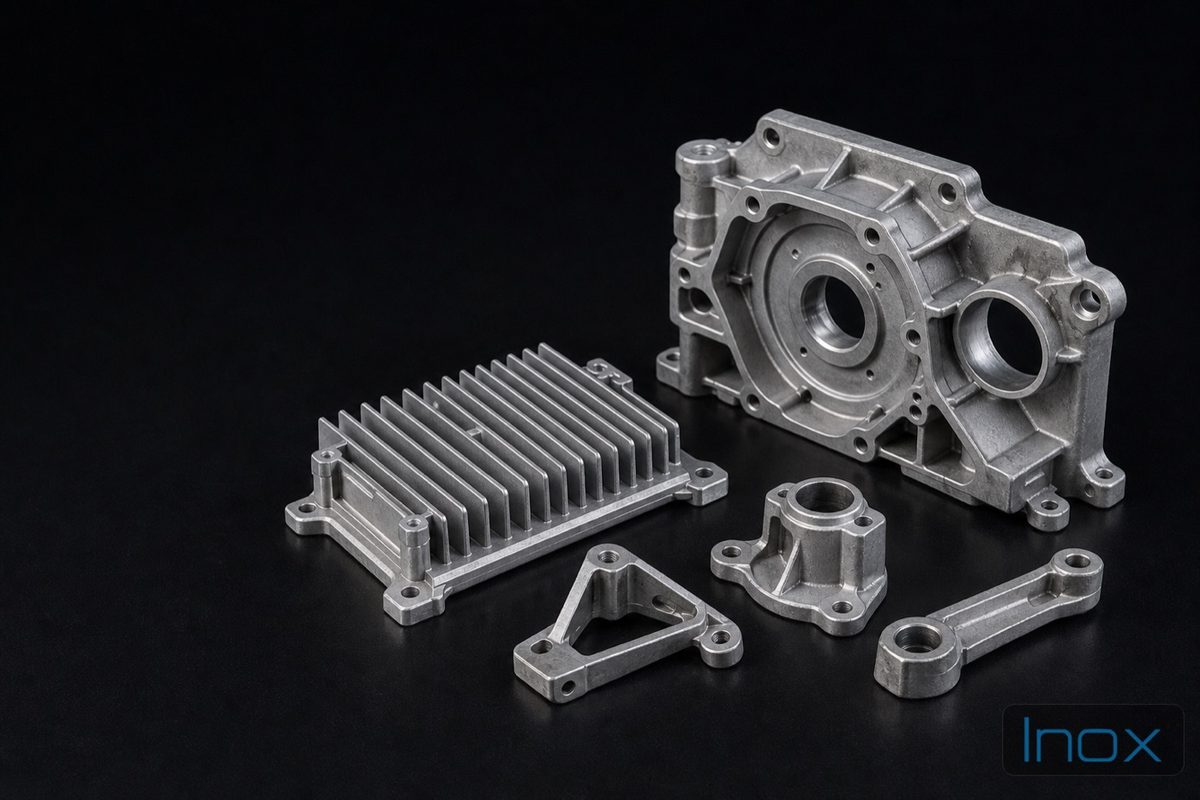
A380: automotive brackets and mounts, motor and gearbox housings, industrial enclosures, general structural castings. ADC12: high-volume consumer electronics housings, appliance components, telecom enclosures with fine fin arrays. A413: pressure-tight housings, pump and fluid bodies, intricate thin-walled geometry where fill is the dominant risk.
Representative application illustration — not a record of a specific customer program.
Aluminum Alloy Families Compared
Qualitative directions, confirmed per part at the engineering review:
| Family | Castability & thin walls | Strength character | Thermal & corrosion | Reach for it when |
|---|---|---|---|---|
| A380-type | Excellent general castability | Good all-round mechanical balance | Good conductivity, acceptable corrosion behavior | Nothing unusual — the sound default |
| ADC12-type | Very good fluidity, friendly to thin sections | Comparable to A380 | Comparable thermal performance | High volume, regional supply depth, thin walls |
| A413-type | Outstanding fluidity for intricate geometry | Moderate strength | Good corrosion resistance | Pressure-tight or intricate thin-wall parts |
Frequently Asked Questions
Is A380 or ADC12 better?
Neither, generally — they are close cousins with overlapping behavior, and for most parts the honest answer is that either works. ADC12's fluidity edge and regional supply depth make it the frequent choice for high-volume parts cast in Asia; A380 remains the reference point Western drawings usually name. The review will tell you when the difference actually matters for your geometry.
Can I specify a grade you don't normally run?
Say so early and we will tell you plainly whether it is feasible and what it costs in supply lead time and process re-qualification. What we will not do is quietly substitute — the alloy in your parts is the alloy on the certificate. If a specialty grade genuinely serves your function, that is a real conversation; if it is inherited from an old drawing, the review will say so.
Do you publish mechanical property tables?
Not on this site. Published alloy datasheets are provided on request during the engineering review, so you read the actual documents with their conditions and test methods rather than a marketing table stripped of context. Material certificates ship with production.
Does the alloy change my tooling?
Not the alloy family within aluminum — all three run cold chamber in the same tooling class. What does change tooling is switching metals entirely: an aluminum die will not run zinc, because shrinkage, gating and steel treatment all differ. That is why the metal question is settled before steel is cut.
How does finishing interact with the alloy choice?
More than buyers expect. Surface porosity and skin quality vary with alloy and fill behavior, and coatings interrogate both — a blister at powder-coat cure is usually a fill story, not a coating story. When your part is finish-critical, the finish specification joins the alloy conversation at the review rather than arriving afterward.
Where to Go Next
Grade confirmation
Let the Part Choose the Alloy
Send the loads, the thermal picture, the geometry and the finish. The review returns the family with reasons — and the datasheet you can audit.
Last reviewed August 2026 · Inox Die Cast, Dongguan