Prototyping
The awkward truth about die casting prototypes: the process that will make your production parts requires the very tool you are trying to justify. So prototyping for die casting is really a bridging strategy — choosing the cheapest route that proves what you actually need proven, before production steel gets cut.
This page lays out the bridge routes we use, what each one can and cannot validate, and how the choice follows from a single question: what are you still unsure about?
How do you prototype a die casting before production tooling?
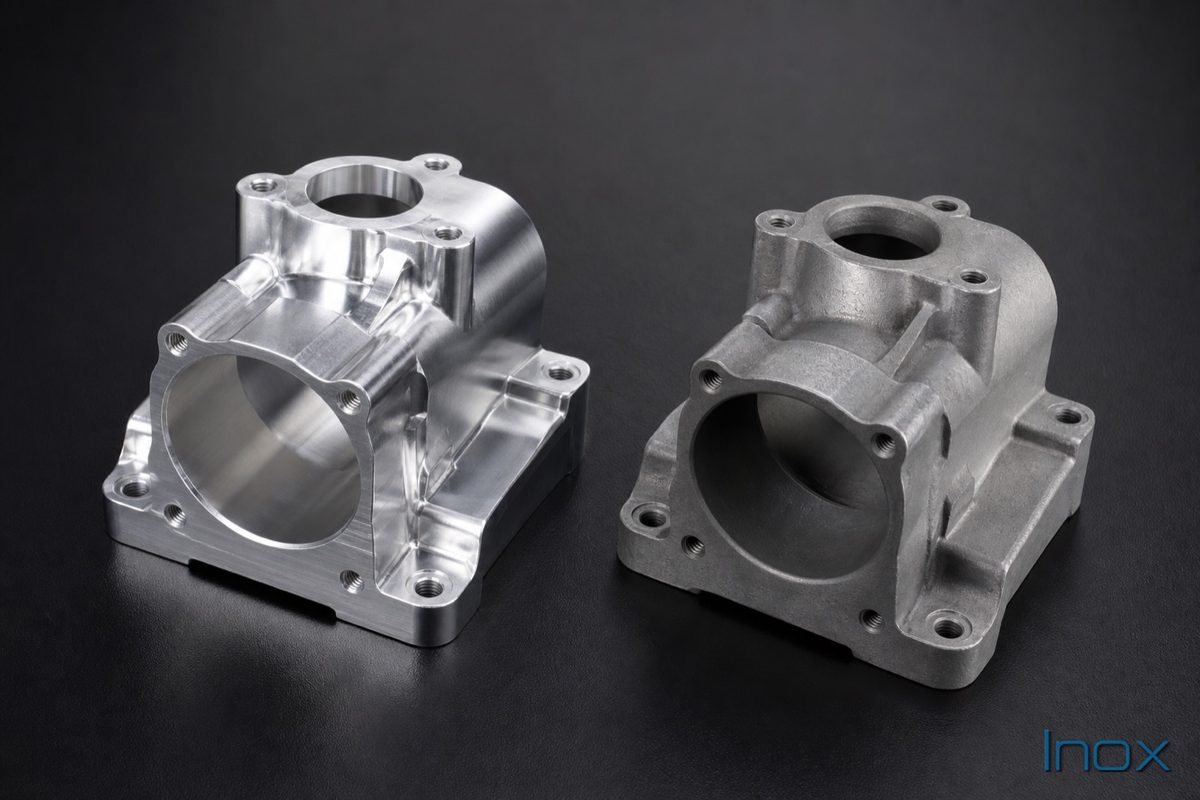
Prototyping a die casting means matching the route to the uncertainty you are testing: machine parts from billet to prove form and fit, or sample from a single-cavity tool that later scales to prove the casting itself. A prototype's job is to kill uncertainty, not to be cheap. Inox Die Cast discusses bridge options at the review so you validate the design before committing production tooling.
At a glance
- Match the route to the uncertainty you are actually testing
- Prototype parts made under production discipline
- Bridge quantities cover you while production steel is cut
- A prototype's job is to kill uncertainty, not to be cheap
Match the Route to the Uncertainty
If the uncertainty is form and fit — does it assemble, does it clear, does the industrial design work in the hand — machined prototypes from solid aluminum answer in days, with no tooling at all. They cost per piece what castings cost per dozen, but for three to twenty validation units that trade is exactly right. What they cannot prove: casting-specific behavior like as-cast surfaces, porosity patterns or thin-wall fill.
If the uncertainty is the process itself — will this thin wall fill, how will the cosmetic face come out, what do a thousand shots teach — a single-cavity tool is the honest instrument. It is real die casting through real steel, producing parts identical in character to production, at a tooling cost far below a multi-cavity production die. Many programs then run the single-cavity tool as early production while volumes ramp, converting the prototype investment into revenue.
If the uncertainty is market volume — the design is proven but demand is not — staged tooling splits the bet: start single-cavity, validate demand with sellable parts, then cut the multi-cavity production tool when the order book justifies it. The unit cost premium during the bridge is the insurance premium against tooling for a market that never arrives.
The wrong answer is the common one: skipping validation to save weeks, then discovering the assembly problem in the first production lot. The review's job is to keep that from happening to you.
Prototype Parts, Production Discipline
Bridge parts get measured like production parts: machined prototypes verified against the drawing, single-cavity trial shots dimensioned and sectioned, results documented and fed straight back into the DFM findings. A prototype that isn't measured is a rehearsal without notes — the value is in what the parts teach, and the teaching gets written down.
The feedback loop is the point. When trial shots reveal a wall that fills reluctantly or a face that ejects with drag, those findings walk downstairs to the tool room and upstream into your design review — while the production die is still a drawing. Programs that budget two weeks for this loop routinely save the two months a production-tool correction would have cost.
Typical Bridge Scenarios
Hardware startups proving fit and finish before their first tooling commitment; equipment OEMs validating a weldment-to-casting conversion on one machine before fleet rollout; electronics programs confirming thermal performance with machined heat-sink prototypes; appliance programs sampling plated cosmetics from a single-cavity tool before family-wide tooling. In every scenario the same discipline applies: name the uncertainty first, then buy only the proof that closes it.
Representative application illustration — not a record of a specific customer program.
Bridge Route Comparison
Three routes, honestly compared — pick by what you still need to prove:
| Route | Proves | Cannot prove | Timeline | Investment |
|---|---|---|---|---|
| Machined from solid | Form, fit, assembly, basic function | As-cast surfaces, porosity, fill behavior | Days | Per piece only |
| Single-cavity tool | Real casting behavior, cosmetics, process window | Multi-cavity balance | Weeks | Fraction of production tooling |
| Staged tooling | Demand, with sellable early parts | Nothing — it defers, not skips | Single-cavity first, scale later | Spread across the ramp |
Frequently Asked Questions
Can you 3D print die casting prototypes?
Printed parts help visualize form early and we're glad you have them, but printed metal differs from die cast metal in structure, surface and detail — it validates shape, not process. For fit-and-function we machine from the actual alloy family; for process truth, only real casting through real steel answers. We'd rather tell you that plainly than sell a misleading rehearsal.
How many machined prototypes make sense?
Typically three to twenty — enough for assembly trials, drop tests and stakeholder hands, few enough that per-piece machining cost stays sensible. Beyond roughly fifty units the single-cavity tooling conversation usually wins, especially if those units could be sold. The quote can show both routes side by side.
Does a single-cavity tool waste money once production tooling exists?
Rarely. It survives as the engineering-change testbed, the overflow capacity for demand spikes, and the insurance tool during production-die maintenance. Programs that started single-cavity almost never regret owning it — the regretted money is usually the multi-cavity die cut for volumes that never materialized.
What's the fastest honest route to validation parts?
Machined prototypes, days after the model settles. 'Fast casting prototypes' beyond that generally means someone else's shortcut with hidden costs. Send the model and the deadline; the review will tell you what is genuinely achievable by when, and what each acceleration actually buys.
Where to Go Next
Validation planning
Tell Us What You're Unsure About
That single answer picks the bridge route. Send the model and the open question — fit, process or market — and the review returns the cheapest honest way to close it.
Last reviewed August 2026 · Inox Die Cast, Dongguan