Hot Chamber vs Cold Chamber Die Casting
The hot chamber versus cold chamber question has a liberating answer: you almost never choose. Your alloy chooses. Zinc runs hot chamber because its low melting point tolerates a submerged injection system; aluminum runs cold chamber because it would destroy one. Pick the metal your part needs, and the machine assignment follows automatically.
So the useful comparison is not 'which machine should I buy time on' but 'what does each machine family mean for my part's cost, precision and possibilities' — which is exactly what this page walks through. We run both families on one floor, so the comparison comes without a sales thumb on the scale.
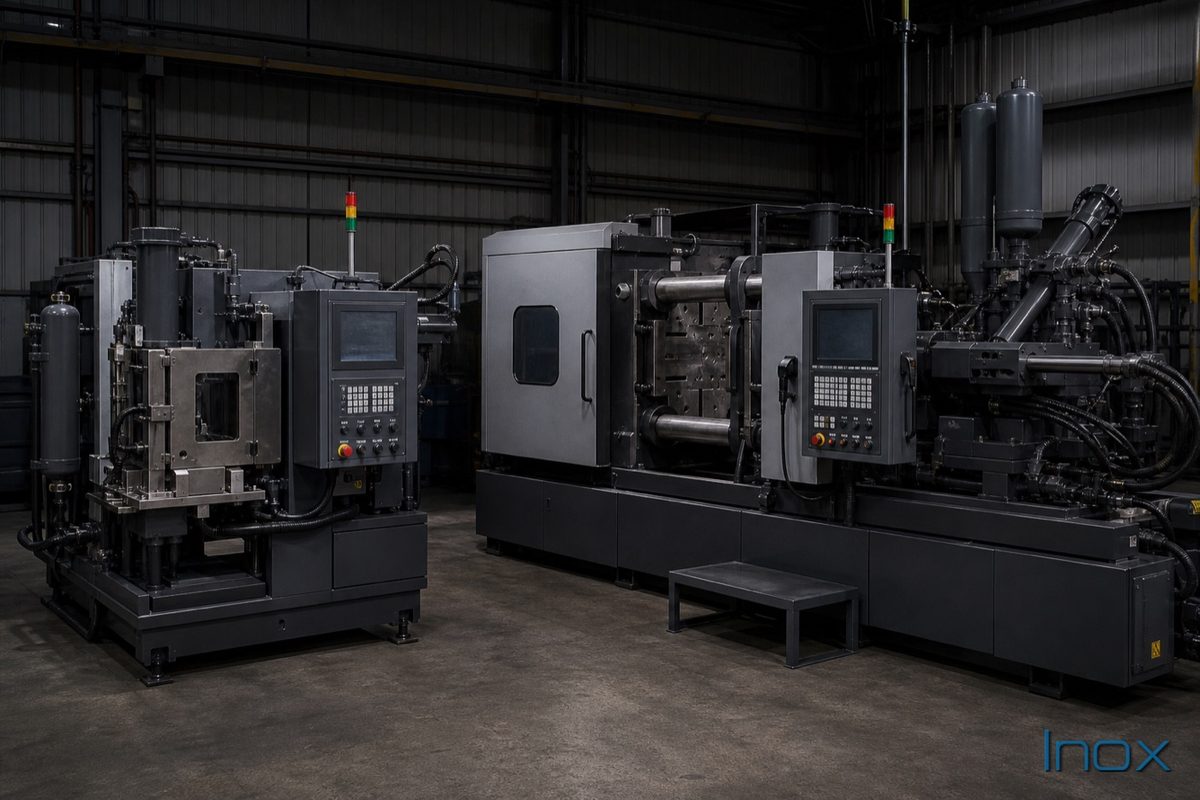
Hot chamber vs cold chamber die casting — what is the difference?
The difference is where the injection system sits. Hot chamber submerges it in the melt for fast cycles and fine detail, and runs low-temperature metals like zinc. Cold chamber ladles metal per shot into a cold sleeve, tolerating aluminum's higher temperature at the cost of speed. In practice the metal chooses the machine: zinc runs hot chamber, aluminum runs cold chamber. Inox Die Cast runs both families on one floor.
At a glance
- The difference is where the injection system lives
- Metal choice usually decides the machine family for you
- Zinc runs hot chamber; aluminum runs cold chamber, almost always
- Both families run on our floor, so the part decides
The Mechanical Difference, In One Minute
Hot chamber: the injection mechanism — a gooseneck and plunger — sits inside the furnace, permanently immersed in molten metal. Every cycle, the gooseneck refills by gravity and the plunger drives the shot into the die. Metal travels centimeters at stable temperature. Result: fast cycles, exceptionally repeatable shots, gentle treatment of everything involved.
Cold chamber: the furnace stands apart, and each cycle begins with a ladle transferring one shot of metal into a horizontal sleeve, from which a plunger drives it into the die. The transfer adds seconds and a little thermal variation, but it is the only architecture that survives aluminum's temperature and chemistry.
Everything buyers experience downstream — zinc's cycle-speed economics, aluminum's larger machine sizes, the difference in tooling life, the precision reputation gap — traces back to this one architectural fork. Neither is better; each is the correct answer to a different metallurgical question.
The practical takeaway for a buyer: settle the alloy first, through function — weight, temperature, detail, finish. The machine, the cycle economics and the tooling profile all cascade from that single decision. Our aluminum-vs-zinc page runs that decision factor by factor.

One Floor, Both Families
Running hot and cold chamber lines in the same plant has a quiet benefit for mixed-metal programs: an aluminum chassis and its zinc detail parts share one engineering contact, one control-plan discipline and one delivery schedule. It also keeps this comparison honest — we profit from whichever machine your part actually needs, so the recommendation follows the part rather than the sales target. Both machine rows feed the same measurement room and the same documentation standard.
Typical Assignments
Hot chamber zinc: locks and hardware, connector shells, gears and mechanisms, plated cosmetic parts, small precise housings. Cold chamber aluminum: motor and gearbox housings, heat-dissipating enclosures, automotive brackets, industrial frames, pump bodies. When one product needs both lists, the mixed-metal program runs under one roof.
Representative application illustration — not a record of a specific customer program.
Hot Chamber vs Cold Chamber: Eight Factors
The full head-to-head, remembering that the alloy usually makes the choice for you:
| Factor | Hot chamber (zinc) | Cold chamber (aluminum) |
|---|---|---|
| Alloys | Zinc families (low melting point) | Aluminum families (high melting point) |
| Metal delivery | Immersed gooseneck, auto-refill | Ladle to sleeve, per shot |
| Cycle speed | Fastest in die casting | Slower — transfer adds seconds |
| Shot consistency | Exceptional — short, sealed path | Good, with disciplined control |
| Machine size range | Small to medium | Small to very large |
| Typical part size | Palm-sized and below | Small through large housings |
| Tooling life | Long — low temperature, gentle delivery | Shorter — thermal stress, managed by maintenance |
| Precision reputation | Fine mechanisms, tight repeatability | Fully capable for its part class |
Frequently Asked Questions
Can the same part run on either machine?
Only by changing its alloy, which changes the part itself — different density, strength, thermal behavior and finishing response. The dies are also not interchangeable between alloys. This is why the material decision comes first and the machine question dissolves: by the time the alloy is right for the function, the machine is already chosen.
Which route is cheaper?
For a small high-volume part that could honestly be either metal, hot chamber zinc usually wins — faster cycles plus longer tool life compound. For anything with a weight budget, thermal duty or physical size, aluminum in cold chamber is not the more expensive option, it is the only option. The quote, not the folklore, settles your specific case.
Is magnesium a hot or cold chamber metal?
Industry-wide it runs in both configurations depending on the process variant — and it is a specialty we deliberately do not claim. If your part genuinely needs magnesium, we will say so at the review and stay honest about it rather than force-fit the design into an alloy we run. Most 'magnesium' inquiries end up well served by thin-wall aluminum or zinc.
Do both machine types deliver the same quality documentation?
Yes — the control-plan discipline, first-article anchoring, sampling records and material certificates are process-independent here. The machine changes the physics; it does not change the paperwork standard your program receives. The quality page walks the full chain station by station.
Where to Go Next
Route review
Settle the Alloy. The Machine Follows.
Send the part and its duties — loads, heat, finish, volume. The review returns the alloy recommendation with the machine route and economics attached, from a floor that runs both.
Last reviewed August 2026 · Inox Die Cast, Dongguan