Aluminum vs Zinc Die Casting
Which die casting alloy should you choose? For most parts the answer follows from three questions: how big is it, how hot does it run, and how many will you make. Aluminum favors larger, lighter, hotter parts; zinc favors smaller, finer, higher-volume parts. Everything else is detail — important detail, which this page walks through factor by factor.
We cast both metals in the same factory, so this comparison has no thumb on the scale. The alloy that suits your part is the one we want to run.
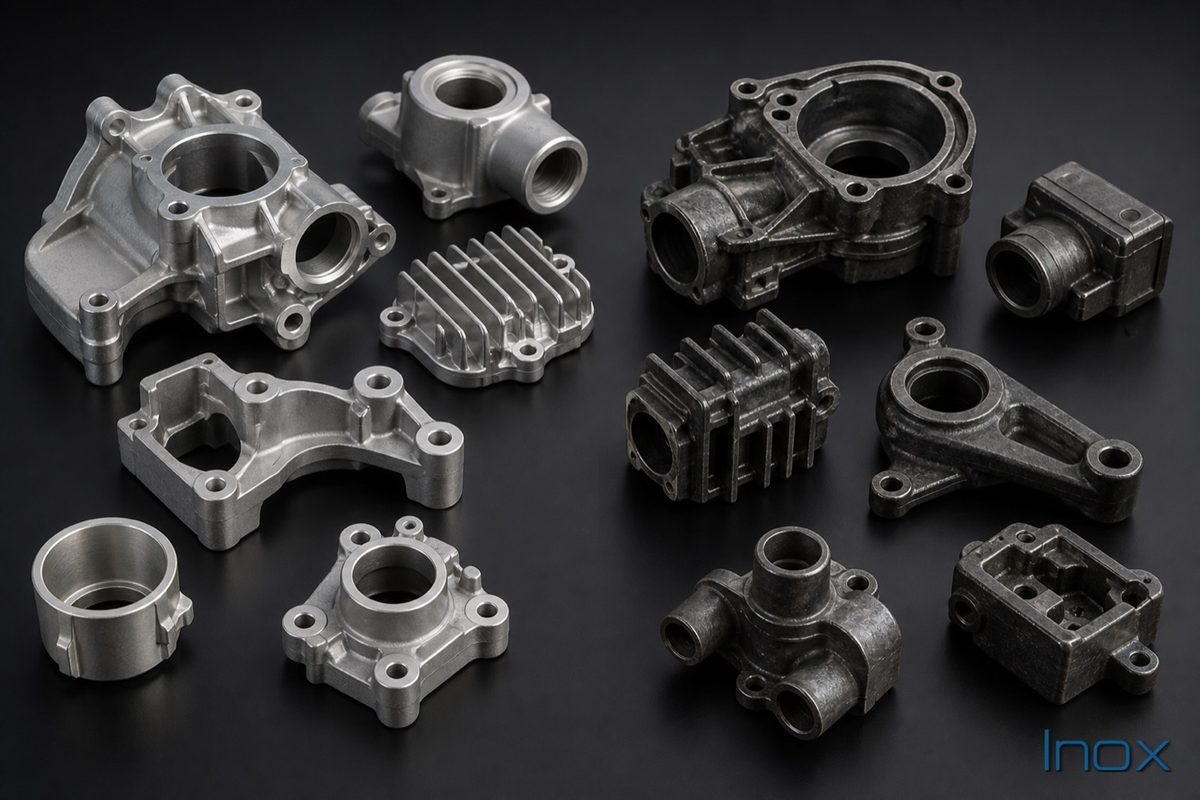
Aluminum or zinc die casting — which should I choose?
Choose aluminum when the part must be light, large, load-bearing for its weight, or shed heat — its strength-to-weight ratio and thermal conductivity win. Choose zinc when the part is small, thin-walled, highly detailed, decoratively plated, or very high-volume — its fine detail, fast cycles and long tool life win. Density, heat and size point to aluminum; detail, thinness and plating point to zinc. Inox Die Cast casts both, so the recommendation follows your part rather than an equipment list.
At a glance
- Weight, heat and size argue aluminum; detail, thin walls and plating argue zinc
- Tooling life and cycle speed favour zinc; large structural parts favour aluminum
- The part decides — we cast both metals, so the advice has no thumb on the scale
- The alloy selector gives a directional answer in one minute
The Shape of the Decision
Start with mass. Aluminum is roughly forty percent the density of zinc, so anything a hand lifts, a vehicle carries or a bracket holds against gravity leans aluminum. If your part's weight budget is written into the spec, the decision is often already made.
Then temperature. Aluminum keeps its mechanical properties at service temperatures that make zinc uncomfortable, and it moves heat well enough to double as the heat sink. Enclosures around power electronics, LED drivers and motors usually land aluminum for this reason alone.
Then geometry and volume. Zinc fills thinner walls and sharper detail than aluminum, cycles faster in hot-chamber machines, and treats tooling so gently that a zinc die can outlive an aluminum die several times over. On a small precision part planned at high annual volume, those three effects compound into a per-piece cost aluminum cannot reach.
Where the factors conflict — a thin-walled part that also runs warm, a structural part that also needs plated cosmetics — the engineering review earns its keep. That conversation is exactly what the request-a-quote form starts.

Both Metals, One Quality System
Aluminum runs on cold-chamber machines and zinc on hot-chamber lines, but both feed the same inspection stations, the same control-plan discipline and the same in-house tool room. Comparing alloys factory-direct means the data behind the recommendation — cycle behavior, tooling wear, finishing results — comes from the same floor, not from two competing vendors' brochures.
Where Each Metal Usually Lands
Aluminum: automotive brackets and housings, telecom and power-electronics enclosures, industrial frames, heat-dissipating parts. Zinc: locks and door hardware, connector shells, gears and small mechanisms, plated decorative parts, appliance fittings. Mixed programs are common — an aluminum chassis carrying zinc detail parts is a classic pairing, and running both under one roof keeps that pairing coordinated.
Representative application illustration — not a record of a specific customer program.
Aluminum vs Zinc: Eight Deciding Factors
Read your part down this table; where most rows point, the material usually follows:
| Factor | Aluminum | Zinc |
|---|---|---|
| Weight | About 40% of zinc's density — wins any mass budget | Heavy for its size; fine for small parts where grams don't matter |
| Strength picture | Better strength-to-weight for structural parts | Higher as-cast surface hardness; strong in small sections |
| Minimum practical walls | Thin walls possible with careful design | The thin-wall champion — finest detail of common casting metals |
| Service temperature | Comfortable in hot environments | Prefers modest temperatures; creep limits hot service |
| Surface finish & plating | Powder coat and paint well; plating possible | The classic plating substrate — chrome-ready as cast |
| Tooling life | Shorter — aluminum is hard on die steel | Several times longer; rewards high-volume programs |
| Cycle speed | Cold-chamber, slower cycles | Hot-chamber, fast cycles |
| Cost driver | Material cost per part on larger geometry | Tooling amortization and cycle speed at high volume |
Frequently Asked Questions
Can I switch alloy after tooling is built?
Not without consequences — aluminum and zinc tools differ in steel treatment, gating and thermal design, and the two metals shrink differently, so a die built for one will not simply run the other. This is why the alloy question is settled during the engineering review, before steel is cut, when changing direction costs a conversation instead of a tool.
Which metal is cheaper?
Neither, universally. Aluminum tends to win on bigger parts where material volume dominates cost; zinc tends to win on small precision parts at high volume, where fast cycles and long tool life do the work. The honest answer is the quotation: send the geometry and the annual quantity and the numbers speak for your specific part.
Is zinc stronger than aluminum?
Zinc has higher tensile strength and hardness in absolute terms; aluminum wins once weight enters the equation. A zinc bracket is strong; an aluminum bracket of equal weight is bigger and often stiffer. Which 'strength' matters depends on whether your constraint is space, mass or load — a distinction the engineering review pins down.
What about magnesium or other alloys?
We focus on what we run at production quality: aluminum and zinc families. If your program genuinely needs magnesium or another specialty metal, we will say so plainly during the review rather than force-fit the part into an alloy we cast. Most parts that arrive asking about magnesium end up well served by thin-wall aluminum or zinc.
Can one product use both metals?
Frequently the best answer. Structural or heat-carrying parts go aluminum, small precise or plated parts go zinc, and both come from the same factory with one engineering contact, one quality system and coordinated schedules — which is the practical advantage of a plant that runs both metals rather than specializing in one.
Where to Go Next
Material decision review
Let the Part Pick the Metal
Send the drawing, the service conditions and the volume. You get back a materials recommendation with reasons — from a factory that runs both metals and has no interest in selling you the wrong one.
Last reviewed August 2026 · Inox Die Cast, Dongguan