Thermal Management in Die Casting
Every watt a device consumes leaves as heat, and someone has to design its way out. In a surprising share of products that someone eventually arrives at an aluminum casting — because the part that already surrounds the electronics is the part best placed to move heat away from them.
This page is about designing that part deliberately rather than discovering it late: where die casting genuinely beats extrusion and skiving, why fins and draft angles are natural enemies, and how a housing turns into a heat sink without becoming an expensive one.
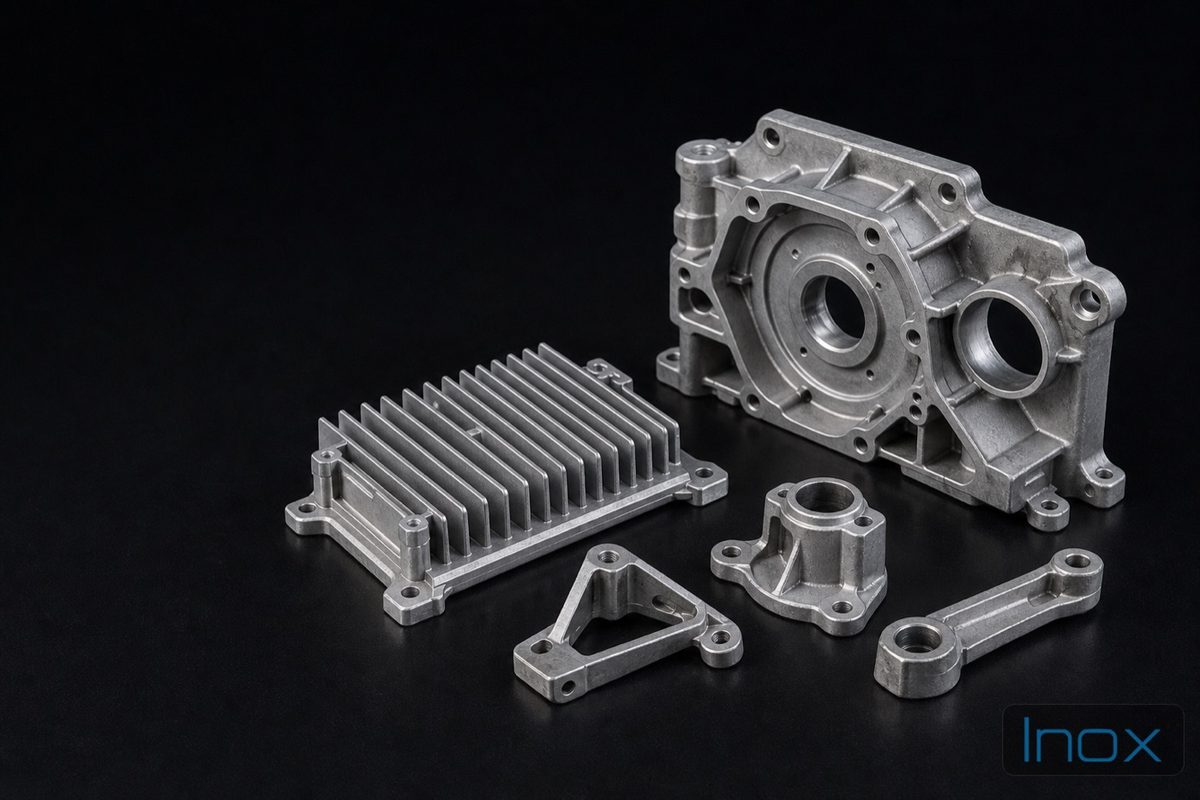
How do you design a die cast heat sink?
A die cast heat sink works when the enclosure is the heat sink — casting the fins into the housing deletes the thermal interface a bolted-on sink adds. The central constraint is draft: ejection thickens every fin at its root, so cast fin fields are bounded and best oriented along the airflow, with a thick conduction path under the heat source. Compare assemblies junction-to-ambient, not fin fields on a datasheet. Inox Die Cast designs the fin field, gate and die opening together.
At a glance
- The enclosure that already exists is the best heat sink you can buy
- Fins fight draft — cast fin fields are bounded, so design around it
- Casting deletes the thermal interface a bolted-on sink adds
- Aluminum, essentially always; gate position decides the conduction path
Why the Housing Becomes the Heat Sink
Aluminum conducts heat well, and a die cast aluminum enclosure is already touching the thing that needs cooling. Bolting a separate extruded sink onto a housing adds an interface, and every thermal interface is a resistance — thermal paste, flatness error, bolt tension, and an assembly step whose quality varies with whoever performed it. Casting the fins into the housing deletes the interface entirely. The heat leaves the die-attach, crosses one continuous piece of metal, and reaches air.
It also deletes a part number, an assembly operation, and a tolerance stack. For LED luminaires, telecom radio units, motor controllers, power supplies and increasingly for the dense equipment filling data halls, the thermal path and the structural enclosure want to be the same casting. Once volumes justify a die, they usually are.
What casting brings that extrusion cannot is freedom in the third dimension. An extrusion has one constant profile along its length — pins, splayed fins, curved ducting or a mounting boss on the fin side are simply not available. A casting can take any shape the die can open around, which means the fin field can follow the actual airflow rather than the geometry the extrusion press permits.

Fins Versus Draft: the Central Fight
Here is the constraint that governs every die cast heat sink. Ejection requires draft — every surface parallel to the die's opening direction must taper, or the part will not release. A fin is a tall thin wall parallel to the opening direction.
Draft therefore makes the fin thicker at its root and thinner at its tip, and the taller you make it, the more the root swells. Somewhere the root eats the gap between fins, and the fin field stops breathing.
So the fin aspect ratio a die casting can hold is bounded, and it is lower than a skived or bonded-fin sink reaches. Deep, dense, near-parallel fin fields belong to skiving, bonding or extrusion. Moderate fins integrated into a structural housing belong to casting. Trying to cast a skived fin field produces a tool that will not fill, will not eject, or will not survive; trying to skive a structural housing produces an expensive brick.
The design levers, once that is understood: orient the fin field so the draft runs along the airflow rather than across it. Accept a taper and design the gap at the root, not at the tip. Use pin fins rather than plate fins where the flow is unducted or its direction is uncertain — pins tolerate draft gracefully and behave far better in natural convection.
Vary fin height across the field so metal reaches the far fins during fill. And put the thick section where the heat source sits, because the casting needs a path from the die-attach to the fin field, and a uniform wall does not provide one.
The failure to avoid: designing the thermal solution first and handing the casting engineer a fin field to make manufacturable. The fin geometry, the gate position and the die's opening direction are one decision. Made together, a casting will move heat impressively for what it costs. Made in sequence, the tool tries to fill a fin field through a path nobody chose, and the porosity lands exactly where the heat needed to cross.
Where Cast Thermal Parts Land
LED luminaire bodies and high-bay housings, where the driver and the emitter share one aluminum path to air. Telecom radio and remote-radio-head enclosures, cooled passively outdoors. Motor controller and inverter housings. Power supply and charger enclosures. Equipment chassis in data halls where the cold plate, the structural frame and the enclosure converge into a single casting. Automotive electronics housings, where vibration rules out bolted-on sinks.
The common thread is not the industry. It is that the part had to exist anyway as an enclosure, and the heat gave it a second job.
Representative application illustration — not a record of a specific customer program.
Casting, Extrusion, Skiving — Choosing the Process
Directional guidance; the actual choice depends on your thermal budget, airflow and volume:
| Dimension | Die casting | Extrusion | Skived or bonded fin |
|---|---|---|---|
| Fin density and height | Moderate — bounded by draft | High, along one axis only | Highest available |
| Freedom in three dimensions | Full — pins, curves, bosses, ducting | None; one constant profile | Fin field only |
| Integration with the enclosure | The housing is the heat sink | Requires a second part and an interface | Requires a second part and an interface |
| Thermal interfaces | None — one continuous casting | One, with paste and bolts | One or more |
| Tooling | A steel die, front-loaded | A profile die, comparatively cheap | Minimal |
| Piece price at volume | Lowest once the die amortises | Low, plus assembly | Highest |
| Best when | Volume, structure and heat arrive together | Low volume, simple straight fin field | Thermal budget dominates everything else |
Frequently Asked Questions
Will a die cast heat sink outperform an extruded one?
Per unit of fin, usually not — extrusion holds taller, thinner, denser fins than draft permits. Per unit of installed product, frequently yes, because the cast version eliminates the thermal interface between sink and housing and can place its fins where the air actually goes. The comparison people make is between fin fields. The comparison that matters is between assemblies, measured from the junction to ambient. Run that comparison on your real airflow and the answer sometimes reverses.
How tall can a cast fin be?
It depends on wall thickness, alloy, fin pitch, the fill path and where the fin sits relative to the gate — which is why we quote no ratio here. The mechanism is what to design against: draft thickens the fin root, so height, pitch and draft trade against one another, and the constraint tightens as the fin sits further from the gate. Bring a target thermal resistance and the airflow rather than a fin drawing, and the achievable field falls out of the review.
Does porosity hurt thermal performance?
Where it lies in the conduction path, yes — gas trapped in the thick section between the heat source and the fin field is exactly the wrong place for a void. This is one reason gate position matters so much on thermal parts: the fill has to bring dense metal to the region the heat must cross. It is also why a thermal casting should be designed with the thick boss and the gate chosen together, and why fin fields are best fed rather than starved.
Aluminum or zinc for thermal parts?
Aluminum, essentially always. Zinc's conductivity is far lower, it is roughly two and a half times as dense, and thermal parts tend to be large — three arguments pointing the same direction. Zinc earns its place on small, detailed, plated or high-volume parts where heat is not the problem. When the casting's job is to move watts, it is an aluminum part, and the alloy conversation happens within the aluminum family.
Can you cast a cold plate with internal channels?
Not as a die casting, if the channel is a closed internal passage — a die has to open around every feature. Cast plates with open channels that a cover closes, or castings with drilled and plugged passages after machining, are routine. Genuinely closed cast-in channels belong to other processes. If you are designing liquid cooling into a casting, bring us the channel concept early, because the answer strongly shapes the part and it is a cheap conversation to have before the design commits.
Where to Go Next
Thermal review
Bring the Watts, Not the Fin Drawing
Tell us the heat load, the airflow and the space you have. The fin field that a die can actually fill and eject is something we work out together — and it usually beats the one drawn without the die in mind.
Last reviewed August 2026 · Inox Die Cast, Dongguan