Die Casting vs Investment Casting
These two processes get compared because both pour metal into a mould and both promise near-net shapes. Almost nothing else about them is alike. One melts a wax pattern out of a ceramic shell that is destroyed to release a single part. The other injects metal at speed into a hardened steel die that will produce hundreds of thousands of parts and still be running.
We cast; we do not do investment casting. That makes this page easy to write honestly, because we have no reason to talk you out of a process we cannot sell you. If your part belongs in investment casting, this page should tell you so clearly enough that you stop reading and go find a good investment foundry.
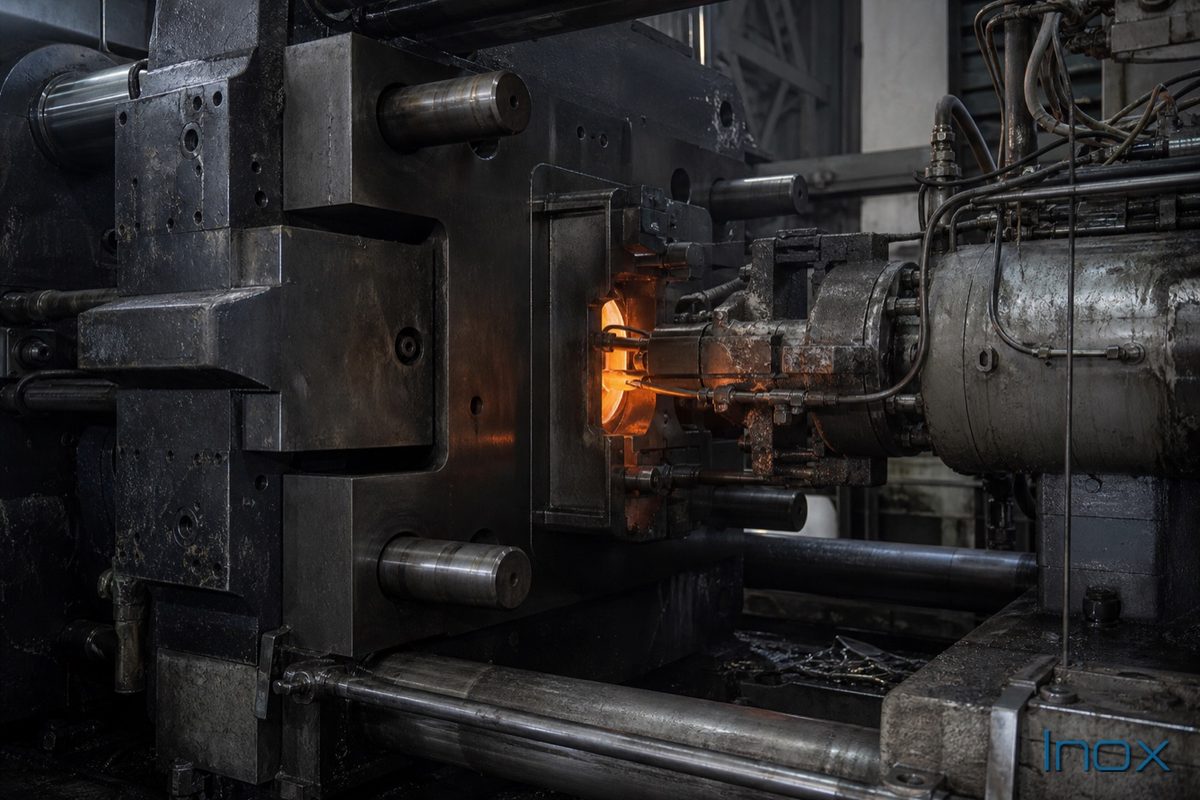
Die casting vs investment casting — what is the difference?
Die casting injects metal into a permanent hardened-steel die reused for the whole program; investment casting pours into a ceramic shell destroyed to release each part. Die casting wins on unit cost at volume, cycle speed and thin walls in aluminum and zinc; investment casting wins on geometric freedom, zero-draft shapes and metals like steel and superalloys a die cannot run. Volume and alloy usually decide it. Inox Die Cast only die casts — and says so when your part belongs in a ceramic shell.
At a glance
- Investment casting wins geometry freedom, steels and low volume
- Die casting wins unit cost, cycle speed and thin walls at volume
- The crossover is where the steel die amortises — no universal number
- We only die cast, so this comparison costs us nothing to write honestly
The Difference Is the Mould, and Everything Follows From It
Investment casting builds a wax replica of your part, coats it in ceramic slurry until a shell forms, melts the wax out, and pours metal into the void. The shell is broken away to get the casting. Every part consumes its own mould.
What that buys is freedom: no draft angles, no parting line to design around, no ejection pins, undercuts and internal passages that no steel die could ever open around. It also runs metals die casting cannot touch — carbon and stainless steels, tool steels, nickel and cobalt superalloys, titanium.
Die casting cuts the mould once, out of hardened tool steel, and then uses it. Metal is injected under high pressure, solidifies in seconds, and the die opens and ejects. That permanent-mould discipline imposes real constraints — draft on every vertical face, a parting line someone has to live with, ejector marks that land somewhere, wall thicknesses that must fill and eject.
In exchange, the part comes out fast, repeatably, with an as-cast surface finer than anything a ceramic shell leaves, and at a piece price that falls as the tooling amortises across the program.
So the question is never which process is better. It is which set of constraints your part can live inside, and whether your volume can pay for a steel die. Those are two independent questions, and either one can decide the part on its own.

Where Each One Actually Wins
Investment casting wins on geometry. If your part has internal passages that curl back on themselves, undercuts a die cannot open around, or a shape that would need side actions in three directions, the ceramic shell simply does not care.
It wins on material: pressure-tight stainless housings, heat-resistant superalloy vanes, and steel structural parts have no die casting equivalent, because those alloys would destroy a steel die. It wins on draft: geometries that must not carry a taper get cast as drawn. And it wins at low volume, because the tooling is a wax injection die — far cheaper than a production die casting tool, and sometimes replaceable by a printed pattern entirely.
Die casting wins on economics at volume, and it wins decisively. The steel die is the expensive part, and it is spent once. From there the cycle is measured in seconds rather than the hours a shell takes to build, dry and fire. The labour content per part is a fraction of investment casting's, because nobody is dipping, drying, dewaxing or knocking out ceramic for your specific part.
Cross the volume where the die amortises, and the piece-price gap widens for the rest of the program's life. On a housing running through hundreds of thousands of units, that gap is usually the whole business case.
Die casting also wins on thin walls in aluminum and zinc, and this surprises people who assume the ceramic shell is the finer process. High injection pressure fills sections that gravity-fed molten metal would freeze off in. Zinc in particular reaches wall thicknesses no investment casting will hold, which is why connector shells, lock components and small mechanism parts are die cast almost universally. And the as-cast surface off a polished die needs less finishing than a ceramic-shell surface, which matters when the next operation is plating or paint.
The honest crossover: investment casting's cost per part barely moves with quantity, because each part rebuilds its mould. Die casting's falls steeply and then flattens. Somewhere those curves cross. Where exactly depends on part size, alloy, cavity count and how hard your geometry pushes the die — which is why anyone quoting you a universal break-even number is guessing. The useful instinct is directional: a few hundred parts almost never justifies a die; a few hundred thousand almost always does; the middle is where an engineering conversation earns its keep.
What Lands Where
Investment casting: turbine and pump components in steels and superalloys, surgical instrument bodies, firearm receivers, valve bodies needing pressure-tight stainless, low-volume structural parts with undercuts, anything where draft is not permitted.
Die casting: aluminum housings and enclosures, heat sinks and thermally loaded covers, zinc connector shells and lock hardware, automotive brackets and mounts, appliance and telecom chassis, decorative plated trim — parts in aluminum or zinc, made in production quantities, where unit cost and repeatability decide the program.
Representative application illustration — not a record of a specific customer program.
Dimension by Dimension
Qualitative directions, not a specification. Every row gets settled against your actual part at the engineering review:
| Dimension | Die casting | Investment casting | What decides it |
|---|---|---|---|
| Mould | Hardened steel die, reused for the life of the program | Ceramic shell, destroyed to release each part | Whether your volume can amortise steel |
| Metals | Aluminum and zinc (also magnesium elsewhere) | Steels, stainless, superalloys, titanium, aluminum | If you need a ferrous or high-temperature alloy, the choice is made |
| Geometry freedom | Draft, parting line and ejection constrain every face | Undercuts, internal passages and zero draft are routine | Whether the part can be redesigned to open in a die |
| Thin walls | Excellent in zinc, strong in aluminum — pressure fills what gravity would freeze | Limited; gravity-fed shells freeze off in thin sections | How thin the thinnest functional wall actually needs to be |
| Tooling cost | High and front-loaded | Comparatively low; sometimes a printed pattern suffices | Program volume, and whether capital or piece price is the constraint |
| Piece price at volume | Falls steeply, then flattens well below investment casting | Nearly flat — each part rebuilds its own mould | Total program quantity |
| Cycle | Seconds per shot, many cavities per die | Hours per shell to build, dry, fire and knock out | How fast the program must ramp |
| As-cast surface | Fine off a polished die; a good plating and paint substrate | Coarser ceramic-shell texture, usually finished after | Whether the cosmetic surface is cast or machined |
Frequently Asked Questions
Which is cheaper?
Neither, until you say how many. Investment casting is cheaper to start, because you are buying a wax die rather than a production steel die, and it stays roughly as expensive per part at part one thousand as at part ten. Die casting demands the steel up front and then rewards you for the rest of the program. A prototype run belongs to investment casting or machining. A production housing running for years belongs to a die. The mistake is comparing quotes at one quantity and generalising the answer.
Can investment casting hold tighter dimensions than die casting?
That depends on the feature, the alloy and the size, and anyone who answers it with a single number is selling something. Broadly, die casting's rigid steel cavity repeats itself shot after shot, which is why high-volume assemblies rely on it. Investment casting's shell is built fresh each time, which trades some repeatability for geometric freedom. We publish no dimensional figures on this site, because they belong in a drawing review with your features and datums in front of us, not in a marketing table.
My part has an internal passage a die cannot open around. Is die casting dead?
Not necessarily. Ask first whether the passage must be cast. Many are cast because the original part was investment cast, not because the function demands it — a drilled or machined passage after casting is often cheaper than the casting freedom that avoided it. If the passage is genuinely uncastable in a die and cannot be machined, then yes, investment casting or a different process owns that part. Send the drawing; that determination takes an engineer minutes, not a project.
Can I convert an investment cast part to die casting?
Frequently, and it is one of the higher-return changes a maturing program can make. It usually requires design work rather than a straight copy: adding draft, relocating a parting line where it will not offend, moving undercuts to secondary machining, and accepting aluminum or zinc where the original was steel. If the volume has grown into the die and the alloy change survives the loads, the piece-price shift is substantial. If the part is steel because it must be steel, the conversation ends there.
You only die cast. Why should I trust this comparison?
Because it costs us nothing to send you away, and it costs us a great deal to take a part that never belonged here. A program that should have been investment cast becomes a die that will not fill, a series of trials, and a customer who leaves. We would rather answer the question honestly, lose the parts that are not ours, and keep the ones that are. Send the drawing and you will get the same answer whether or not it ends in an order.
Where to Go Next
Process review
Send the Part, Not the Process
Tell us the geometry, the alloy it has to be, and the quantity over the program's life. If it belongs in a die you will hear why — and if it belongs in a ceramic shell, you will hear that too.
Last reviewed August 2026 · Inox Die Cast, Dongguan