Gravity and Low Pressure Die Casting
Most of this site is about high pressure die casting, because that is where most aluminum and zinc parts end up. But high pressure is not the only way to fill a steel die, and for some parts it is the wrong way. Gravity die casting and low pressure die casting use the same permanent steel tooling idea with a much calmer fill, and that calm buys things high pressure cannot: thicker sound sections, fewer trapped gases, and castings that can be heat-treated.
We run gravity and low pressure casting alongside our high pressure lines, so this page compares the three on what they actually do to a part. Machine sizes, alloys and heat treatment for a specific program are confirmed at the engineering review, against the part rather than in general.
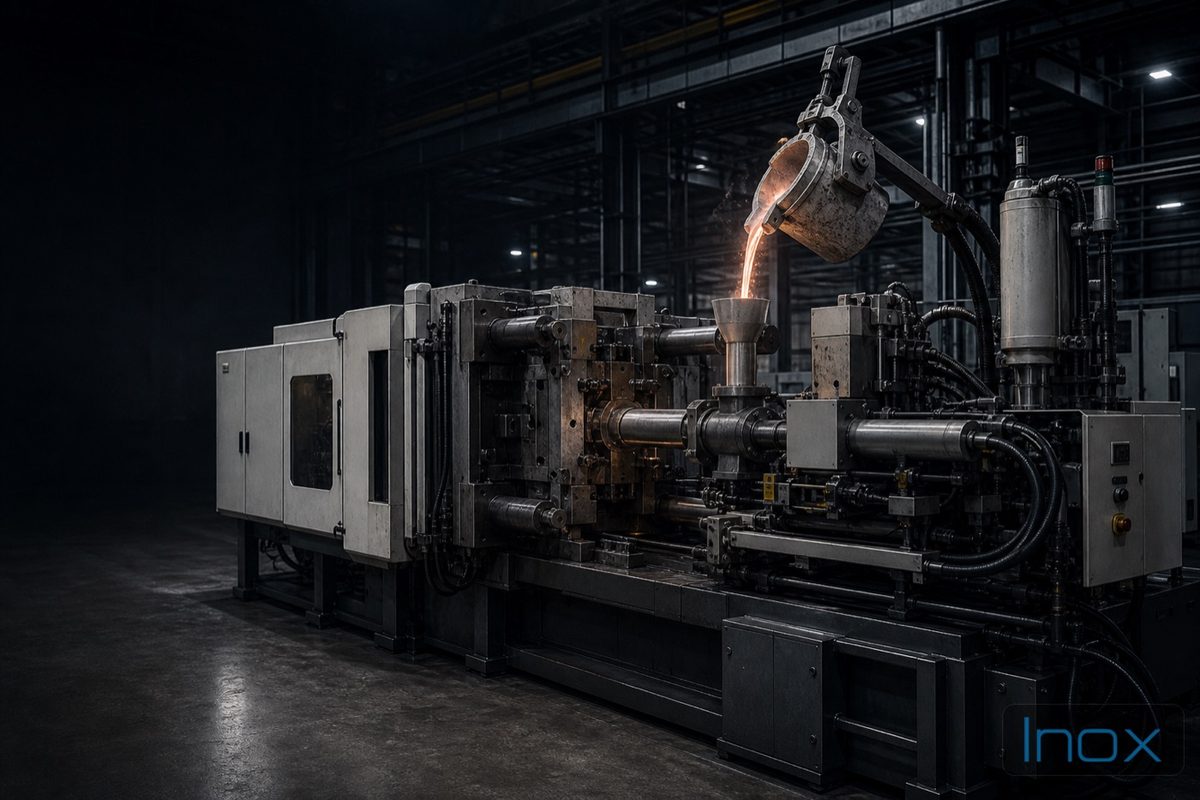
What is the difference between gravity, low pressure and high pressure die casting?
All three fill a reusable steel die. Gravity die casting — also called permanent mold casting — pours metal in from the top and lets gravity fill it. Low pressure die casting pushes metal up into the die from a sealed furnace below at gentle pressure. High pressure die casting injects metal at speed and high pressure. Slower, calmer filling gives sounder, heat-treatable parts; fast high-pressure filling gives thin walls and short cycles. Inox Die Cast runs all three.
At a glance
- Same reusable steel die, three very different ways to fill it
- Gravity and low pressure fill calmly: sounder sections, heat-treatable parts
- High pressure fills fast: thinnest walls, shortest cycles, lowest unit cost
- We run all three — the part decides which one it gets
Three Ways to Fill the Same Kind of Die
Gravity die casting is the oldest of the three. Molten metal is poured into the top of a preheated steel die and fills it under its own weight, often with the die tilted so the metal flows in smoothly rather than splashing. The die is usually coated, and sand cores can be added for internal passages that a steel core could not be pulled out of. Americans tend to call this permanent mold casting; in Britain and Europe it is gravity die casting. They are the same process.
Low pressure die casting turns the fill upside down. The die sits above a sealed furnace, and gas pressure on the melt pushes metal up a riser tube into the die from below. The pressure is low — far below what a high pressure machine uses — but it is held while the casting solidifies, feeding metal into the part as it shrinks. Because the metal rises quietly from below and the riser draws from under the surface of the melt, oxides and entrained air stay out of the part.
High pressure die casting is the one most of this site describes: a plunger drives metal into the die in a fraction of a second, at pressures high enough to fill very thin walls before they freeze. That speed is the source of everything good about it — thin walls, crisp detail, short cycles — and of its main limitation: turbulent, fast filling traps small amounts of gas in the part.
So the choice between them is mostly a choice about filling speed. Fill slowly and the part is sound, dense and heat-treatable, but walls must be thicker and cycles are longer. Fill fast and the part is thin, detailed and cheap per piece, but carries gas that limits heat treatment and welding.
What Each Process Does to the Part
Soundness and heat treatment are where gravity and low pressure win. A calmly filled casting has little trapped gas, so it can go through solution heat treatment and aging without the surface blistering. That opens heat-treatable aluminum alloys of the A356 type, whose strength and ductility after heat treatment put them into structural and safety-relevant parts. High pressure castings usually cannot follow, which is why a part that needs that strength is often moved off the high pressure machine rather than redesigned around it.
Low pressure has a particular advantage on parts that must be pressure-tight or are round and symmetrical. Holding pressure through solidification feeds shrinkage from a single central gate, and the bottom fill keeps oxide films out. That is why cast aluminum car wheels are the classic low pressure part, and why it suits housings that must hold fluid without impregnation.
Gravity casting is the simplest and most flexible of the three. The tooling is less complex than a high pressure die, sand cores can create internal shapes that steel cores cannot, and the process tolerates thicker sections and larger section changes. For moderate volumes of sound, thick-walled parts — pump and valve bodies, manifolds, brackets that will be heat-treated — it is often the most economical route.
High pressure wins on thin walls, detail and unit cost. Cycle times are measured in seconds rather than minutes, a die often carries several cavities, and walls can be a fraction of the thickness gravity-filled metal will reach. For housings, covers, heat sinks and enclosures made in large volumes, nothing else comes close on piece price.
Volume and geometry usually settle it. Thin-walled parts in large volumes belong in high pressure. Thick, sound, heat-treated or pressure-tight parts in moderate volumes belong in gravity or low pressure. Where a part sits between the two, the review weighs the cost of heat treatment and thicker walls against the cost of porosity control and impregnation — and because we run all three, we have no reason to push a part toward the process we happen to own.
Typical Parts by Process
Gravity die casting (permanent mold): pump and valve bodies, hydraulic and pneumatic manifolds, cylinder heads, brackets and suspension parts that will be heat-treated, parts with internal passages formed by sand cores.
Low pressure die casting: aluminum wheels, large round or symmetrical housings, motor and pump housings that must be pressure-tight, structural parts where soundness matters more than wall thickness.
High pressure die casting: thin-walled housings, covers, enclosures and heat sinks, connector shells and lock hardware in zinc, brackets and mounts made in large volumes.
Representative application illustration — not a record of a specific customer program.
Gravity, Low Pressure and High Pressure Side by Side
Qualitative directions, not a specification — each row is settled against your part at the engineering review:
| Dimension | Gravity (permanent mold) | Low pressure | High pressure |
|---|---|---|---|
| How the die fills | Poured from the top, gravity fills | Pushed up from a sealed furnace below | Injected at speed by a plunger |
| Filling speed | Slow, calm | Slow, controlled | Very fast, turbulent |
| Trapped gas / porosity | Low | Lowest | Present — controlled, not eliminated |
| Heat treatment | Routine | Routine | Usually not — gas blisters |
| Wall thickness | Thicker | Moderate to thick | Thinnest |
| Internal shapes | Sand cores possible | Sand cores possible | Steel cores and slides only |
| Cycle time | Minutes | Minutes | Seconds |
| Unit cost at volume | Moderate | Moderate | Lowest |
| Typical parts | Valve and pump bodies, manifolds | Wheels, pressure-tight housings | Housings, covers, heat sinks |
Frequently Asked Questions
Is gravity die casting the same as permanent mold casting?
Yes. Permanent mold casting is the usual American name and gravity die casting the British and European one. Both mean pouring metal into a reusable metal die and letting gravity fill it, sometimes with the die tilted to keep the pour smooth.
What is the difference between low pressure and high pressure die casting?
Low pressure die casting pushes metal gently up into the die from a sealed furnace below and holds that pressure while the part solidifies. High pressure die casting injects metal at speed with a plunger. Low pressure gives sounder, heat-treatable parts with longer cycles; high pressure gives thinner walls and much shorter cycles, with some trapped gas.
Why can gravity and low pressure castings be heat-treated when high pressure ones usually cannot?
Because they fill slowly enough that very little gas is trapped in the metal. In a high pressure casting, the fast, turbulent fill leaves small gas pores; heating the part for solution treatment makes that gas expand and blister the surface. Calmly filled castings do not carry that gas, so they can be heat-treated to higher strength.
Do you run gravity and low pressure die casting?
Yes — alongside our high pressure lines. Machine sizes, the alloy and whether the part is heat-treated are confirmed per program at the engineering review, against the actual part rather than in general.
Which process is cheapest?
At large volumes, high pressure, because cycles are seconds and dies carry several cavities. At moderate volumes, or when a part must be heat-treated or pressure-tight, gravity or low pressure is often cheaper overall, because the alternative is thicker high pressure walls plus porosity control and impregnation. The answer depends on the part and the quantity, which is why it is settled at review.
Where to Go Next
Process review
Send the Part — We Run All Three
Send the model, the alloy requirement and the volume. We will tell you whether it belongs in gravity, low pressure or high pressure, and why.
Last reviewed October 2026 · Inox Die Cast, Dongguan