Die Casting vs Sand Casting
Sand casting is the oldest way of shaping metal still in industrial use, and for good reasons: the mold is made of sand, the pattern can be wood or printed plastic, and there is almost no limit on how big the part can be or which alloy it uses. Die casting is the opposite bargain — a steel die that costs real money, in exchange for parts that come out fast, thin, smooth and nearly identical for hundreds of thousands of shots.
We die cast; we do not sand cast. That makes this comparison easy to write without an agenda. If your part belongs in sand, this page should make that clear quickly enough that you go and find a good sand foundry.
What is the difference between die casting and sand casting?
Sand casting pours metal by gravity into a sand mold that is broken up after each part; die casting injects metal under high pressure into a reusable hardened-steel die. Sand casting has cheap tooling, handles very large parts and almost any alloy, but gives a rough surface and looser dimensions. Die casting needs an expensive die but makes thin-walled, smooth, consistent parts in seconds. Volume usually decides it.
At a glance
- Sand casting: cheap pattern, any size, almost any alloy, rough surface
- Die casting: costly steel die, thin walls, fine finish, seconds per part
- Tooling cost points to sand; unit cost at volume points to die casting
- Heat-treatable, very large or ferrous parts usually belong in sand
Two Opposite Bargains
In sand casting, a pattern shaped like the part is pressed into bonded sand to form a cavity, cores are set for internal passages, and molten metal is poured in under gravity. When the metal freezes, the sand is shaken off and the mold is gone. The pattern survives and makes the next mold. Pattern costs are low — a fraction of a die casting die — and patterns can be changed cheaply when the design changes.
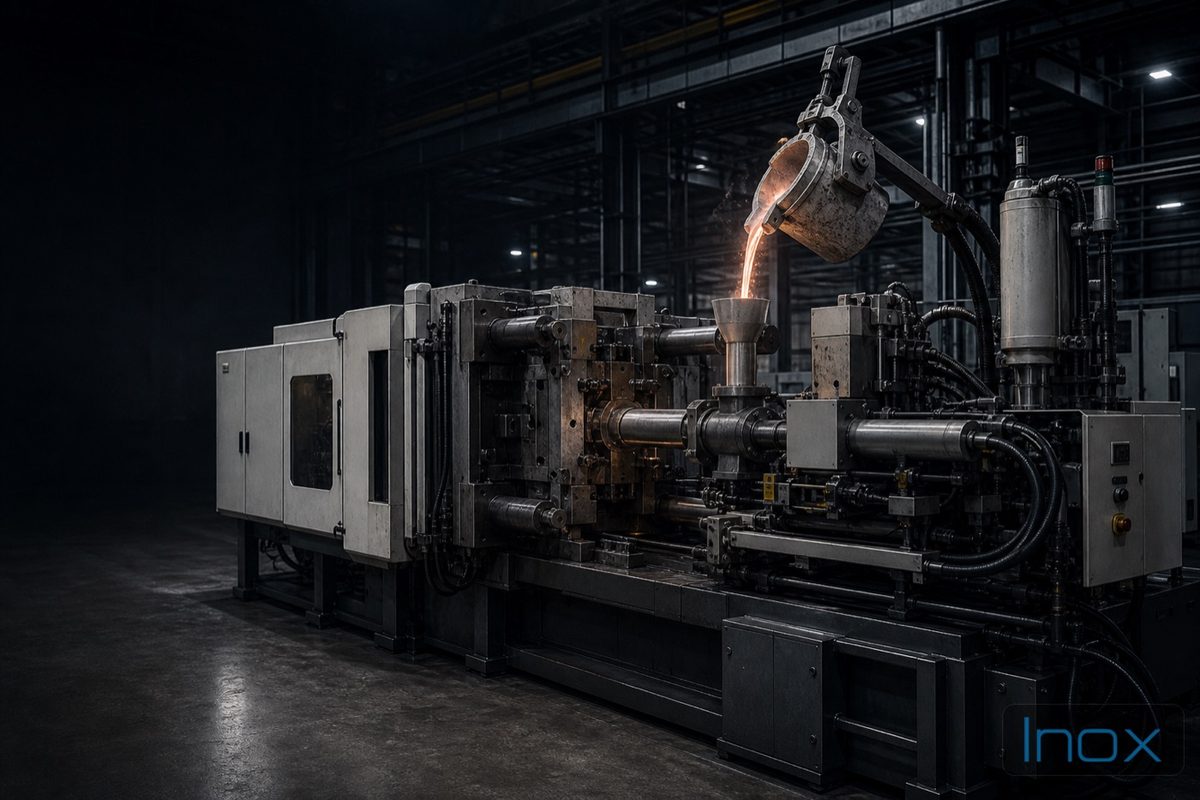
In die casting, the cavity is machined into hardened tool steel, and metal is injected under high pressure. The part solidifies in seconds, the die opens, the part is ejected, and the die closes for the next shot. The die is expensive and slow to make, but it is spent once and then produces parts at a pace sand casting cannot approach.
Pressure is the hidden difference. Gravity-poured metal in a sand mold freezes off in thin sections, so sand castings need thicker walls. Die casting forces metal into sections a fraction as thick and holds it there while it solidifies. Thinner walls mean less metal per part, lighter parts, and less machining to remove excess — savings that compound at volume.
So the question is never which process is better. It is whether your quantity can pay for a steel die, and whether your part can live within die casting's constraints on size, alloy and draft. Either question can decide the part on its own.
Where Each One Wins
Sand casting wins on tooling cost and flexibility. A pattern costs a small part of what a production die does, and a design change means modifying wood or reprinting plastic rather than re-machining hardened steel. For prototypes, spares, and programs of a few hundred or a few thousand parts, sand casting usually reaches a lower total cost even though each part costs more.
Sand casting wins on size. Parts weighing hundreds of kilograms — pump bodies, machine bases, large valve housings — are routine in sand and impossible in a die, where the machine's clamping force limits the area that can be cast.
Sand casting wins on alloy range and heat treatment. Iron, steel, bronze and heat-treatable aluminum alloys such as A356 all run in sand. Because sand castings are poured gently, they can be solution-treated and aged to high strength. Conventional high-pressure die castings usually are not heat-treated, because gas trapped during the fast fill expands and blisters the surface in the furnace.
Die casting wins on unit cost at volume, and it wins by a wide margin. Cycle times are seconds rather than the minutes it takes to make, pour and shake out a sand mold, dies often carry several cavities, and labor per part is a fraction of a sand foundry's. Once the die is amortised, the gap widens for every remaining part of the program.
Die casting wins on surface finish and consistency. Parts come off a polished steel die with a smooth surface that can go straight to painting, powder coating or plating, while sand castings carry the texture of the sand and usually need more finishing. And because every part comes from the same steel cavity, part-to-part variation is far smaller than from molds rebuilt for every pour — which means fewer machined surfaces and simpler inspection. We do not publish tolerance numbers for either process; what a specific feature can hold depends on its size, location and the parting line, and it is settled at the review.
The crossover is real but not universal. Sand casting's cost per part barely falls with quantity; die casting's falls steeply as the die amortises, then flattens. Where they cross depends on part size, alloy, cavity count and how much machining each route needs. A few hundred parts almost never justifies a die. Tens of thousands per year almost always does. The middle is where an engineering conversation earns its keep.
What Lands Where
Sand casting: large pump and valve bodies, machine bases and frames, engine blocks for low-volume and heavy equipment, iron and steel parts, heat-treated aluminum structural parts, prototypes and spares, and any part too big for a die casting machine.
Die casting: aluminum and zinc housings and enclosures, heat sinks, brackets and mounts, connector shells and lock hardware, appliance and telecom chassis, automotive and EV housings — parts made in production quantities where unit cost, thin walls and a finish-ready surface decide the program.
Representative application illustration — not a record of a specific customer program.
Dimension by Dimension
Qualitative directions, not a specification — every row gets settled against your actual part:
| Dimension | Die casting | Sand casting | What decides it |
|---|---|---|---|
| Mold | Hardened steel die, reused for the program | Sand mold, destroyed after each part | Whether your volume can amortise steel |
| Tooling cost | High and front-loaded | Low; patterns are cheap to change | Program volume and design stability |
| Unit cost at volume | Low once the die is paid for | Stays high — every part needs a new mold | Total program quantity |
| Cycle | Seconds per shot, often multi-cavity | Minutes per mold to make, pour and shake out | How fast the program must ramp |
| Wall thickness | Thin — pressure fills what gravity cannot | Thicker — gravity-fed metal freezes off | Weight and material cost targets |
| Surface finish | Smooth off a polished die, finish-ready | Sand texture, usually finished after | Whether the cosmetic surface is cast or machined |
| Part-to-part consistency | High — one steel cavity | Lower — a new mold each time | How many surfaces must be machined |
| Part size | Limited by machine clamping force | Very large parts are routine | Part weight and projected area |
| Alloys | Aluminum, zinc, magnesium | Iron, steel, bronze, aluminum including heat-treatable grades | Whether the alloy is fixed by the application |
| Heat treatment | Usually not — trapped gas blisters | Routine (for example A356-T6) | Whether the strength requires heat treatment |
Frequently Asked Questions
Which is cheaper, sand casting or die casting?
It depends on how many you need. Sand casting is cheaper to start because a pattern costs far less than a steel die, but each part stays relatively expensive. Die casting costs more up front and much less per part once the die is paid for. Low volumes and prototypes usually favor sand; production volumes usually favor die casting.
Why is die casting tooling so much more expensive than sand casting patterns?
A die casting die is machined from hardened hot-work tool steel, has to survive molten metal injected at high pressure thousands of times, and carries cooling, venting, ejection and often slides. A sand casting pattern only has to shape sand and can be wood, resin or printed plastic. The die is a production machine; the pattern is a template.
Which gives a better surface finish?
Die casting. Parts come off a polished steel die with a smooth surface suitable for painting, powder coating or plating. Sand castings carry the texture of the sand and usually need blasting, machining or filling before a cosmetic finish.
Can die castings be heat-treated like sand castings?
Usually not. High-pressure die casting fills the die so quickly that small amounts of gas are trapped inside the part, and heating it in a furnace makes that gas expand and blister the surface. Sand castings fill gently and can be solution-treated and aged — A356-T6 is the classic example. Vacuum-assisted die casting and special alloys narrow this gap for some structural parts.
Do you do sand casting?
No. Inox Die Cast only die casts. If your part belongs in sand — because it is very large, low-volume, iron or steel, or needs heat treatment — the review will say so rather than force it into a die.
Where to Go Next
Process review
Send the Part and the Quantity
Tell us the part, the alloy and how many you need over the program. If a die pays for itself, we will show you how; if sand is the better answer, you will hear that too.
Last reviewed October 2026 · Inox Die Cast, Dongguan