Electric Vehicle Castings
Gigacasting made electric vehicle castings famous, and it also distorted the picture. The headlines are about single castings the size of a car's rear floor, made on presses of six thousand tonnes and more. The reality on most EV programs is a long list of smaller, demanding castings — motor housings, inverter boxes, battery structure — that decide cost, weight and thermal performance just as much.
This page walks through which EV parts are cast and why, what gigacasting actually changed, what structural castings demand from a supplier, and where a factory like ours fits. Our largest machine is a 4,000-tonne L.K., running aluminum or magnesium. That is serious capacity for housings and mid-size structure. It is not a gigacasting press, and the honest version of this page says so.
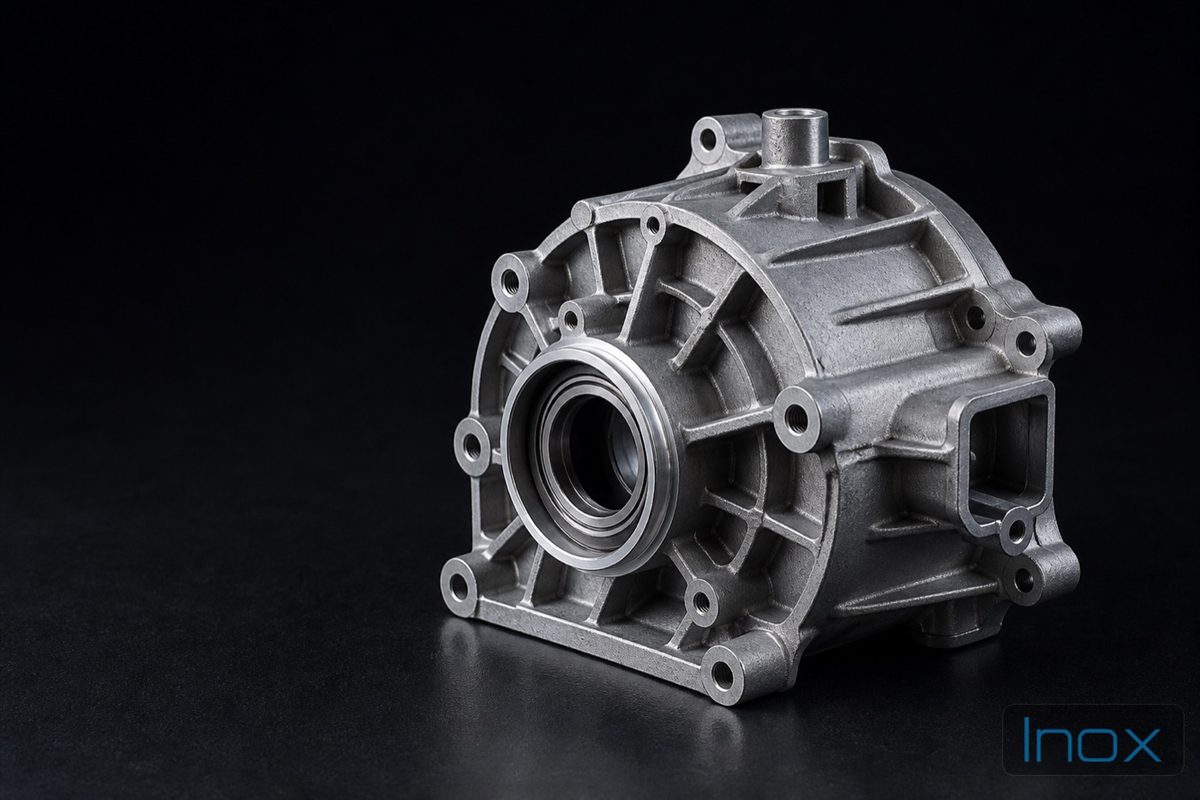
Which electric vehicle parts are die cast?
Most of an EV's castings are housings and structure: e-drive motor and reducer housings, inverter and on-board charger housings, battery pack structural parts, shock towers and structural nodes — and, on some vehicles, a single large front or rear underbody cast on a 6,000-tonne-plus 'gigacasting' press. Aluminum dominates; magnesium appears where weight matters most. Most EV castings are mid-size parts made on conventional machines, not gigacastings.
At a glance
- Most EV castings are housings and mid-size structure, not gigacastings
- Gigacasting replaces dozens of stamped parts with one, on 6,000 t+ presses
- Structural castings need ductility, low porosity and proof — not just tonnage
- Our largest machine is a 4,000-tonne L.K.: housings and nodes, not underbodies
What Gets Cast in an Electric Vehicle
Take the engine out of a car and you remove its biggest castings — the block, the head, the transmission case. Electric vehicles did not end casting demand; they moved it. The castings migrated to the drive unit, the power electronics and the body structure, and several of them got harder to make.
The e-drive comes first. The motor housing holds the stator and has to conduct heat away from it, often through cooling channels cast into the wall. The reducer or gearbox housing carries the bearings that set gear mesh, so its bores must stay where the drawing puts them under load and heat. Many drive units integrate both into one casting, which raises the stakes on porosity because a leak path into a coolant jacket scraps the part.
Power electronics come next. Inverter and on-board charger housings combine three jobs: a sealed enclosure, a heat sink for the power modules, and an electromagnetic shield. Die cast aluminum does all three in one part, which is why these housings are cast rather than fabricated.
Then the battery. Pack structures use castings for corner nodes, end plates, cross members and, on some designs, large tray sections, because a casting can put stiffening ribs and mounting bosses exactly where they are needed. Crash and sealing requirements make these some of the most demanding castings on the vehicle.
Finally the body. Shock towers, longitudinal member nodes and suspension mounts have moved from welded steel assemblies to aluminum castings on many vehicles, because one casting replaces several stampings, their welds and their fixtures. Gigacasting is the far end of that same idea.
What Gigacasting Changed — and What It Did Not
Tesla's move, starting with the Model Y, was to cast the rear underbody as one piece on a press of around six thousand tonnes, replacing dozens of stamped and welded parts. The appeal is plain: fewer parts, fewer joints, less factory floor, less tooling across the body shop. Other carmakers have since announced their own large castings, and presses have grown well beyond six thousand tonnes.
What it did not change is the physics of casting large thin sections. A gigacasting needs alloys developed to reach adequate ductility without heat treatment, because heat-treating a part that size invites distortion and blistering. It needs vacuum-assisted casting to keep gas porosity down across a part metres long. It needs dies that cost as much as a small factory and take months to build and revise. And it moves the repair question: a damaged single-piece underbody is harder to fix than a welded assembly, which insurers and fleet owners have noticed.
So gigacasting suits very high-volume platforms whose owners can afford the die, the press and the development. For everything else on an EV — and for most EV programs outside the largest carmakers — the castings are conventional in size and demanding in quality. That is where the volume of EV casting work actually sits.
Structural castings, large or small, raise the same bar. The alloy must deliver elongation, not just strength, so the part deforms in a crash instead of fracturing. Porosity must be controlled where loads run and where seals sit, which is a matter of gating design, venting, and often vacuum assistance. And the supplier must be able to prove it: X-ray or CT inspection on critical sections, mechanical testing on cut-up parts, and a process window that stays put across shifts.
Where does a 4,000-tonne machine fit? Clamping force limits the projected area a machine can cast, so the question for any part is its size and geometry, not the headline tonnage. Our largest machine is a 4,000-tonne L.K. — the class for large motor and drive housings, inverter housings, battery end plates and nodes, and mid-size structural parts. It is not a gigacasting press and does not make single-piece underbodies. The same machine casts aluminum or magnesium depending on the melting and feeding equipment, so weight-critical parts can be quoted in either metal.
When you send an EV casting for review, the useful questions are the ones above: which alloy and what elongation the part actually needs, where porosity is unacceptable, what inspection proves it, and which machine the part runs on and why. A supplier who answers only with tonnage has answered the easiest question.
EV Castings by Size Class
Small and medium (conventional machines): connector and sensor housings, charge-port parts, small brackets, motor end covers, cooling manifolds, electronics covers — high volume, often aluminum, sometimes zinc for precise small parts.
Large (the class our 4,000-tonne machine serves): motor and reducer housings, integrated drive unit housings, inverter and on-board charger housings, battery pack end plates and nodes, shock towers and structural nodes, and magnesium parts such as instrument panel beams and seat frames where weight is critical.
Gigacasting (6,000 tonnes and up): single-piece front and rear underbodies and large battery tray sections on high-volume platforms with dedicated press lines.
Representative application illustration — not a record of a specific customer program.
Questions That Decide an EV Casting
Directional, not a specification — these get answered against your part at the engineering review:
| Question | Why it matters | What to ask the supplier |
|---|---|---|
| Which alloy, and what elongation? | Structural parts must bend in a crash, not shatter | Which alloy, and how elongation is verified on real parts |
| Where is porosity unacceptable? | Seals, coolant jackets and load paths fail first | Gating and venting approach; whether vacuum assistance is used |
| How is it inspected? | Internal defects are invisible from outside | X-ray or CT on critical sections, sampling plan, cut-up testing |
| Which machine, and why? | Projected area sets the clamping force needed | The specific machine and the reasoning, not just the largest tonnage owned |
| Aluminum or magnesium? | Magnesium saves about a third of the weight at higher alloy cost | Whether both are quoted, and the weight saved per vehicle |
| Heat treatment? | Large thin castings distort and blister when heat-treated | Whether the alloy reaches spec as-cast |
Frequently Asked Questions
What is gigacasting?
Gigacasting is high-pressure die casting of very large single parts — typically a car's front or rear underbody — on presses of roughly six thousand tonnes and more. It replaces dozens of stamped and welded parts with one casting. It needs specially developed alloys, vacuum-assisted casting and very expensive dies, so it suits high-volume platforms with dedicated press lines.
Can you make gigacastings?
No. Our largest machine is a 4,000-tonne L.K., which covers large housings and mid-size structural parts but not single-piece underbodies. If your part needs a 6,000-tonne-plus press, we will tell you that at the review rather than quote something we cannot make.
Which EV parts can a 4,000-tonne machine cast?
Large motor and reducer housings, integrated drive unit housings, inverter and on-board charger housings, battery end plates and nodes, shock towers and mid-size structural parts. The real limit is the part's projected area and geometry, so the answer for a specific part comes from its model, not from the tonnage alone.
Is magnesium used in electric vehicles?
Yes, where weight is worth the higher alloy cost — instrument panel beams, seat frames, steering wheel armatures and some housings, and on electric two-wheelers, frame parts and motor housings. A magnesium part weighs about two-thirds of the same aluminum part. Our 4,000-tonne machine can run either metal depending on the feeding setup.
Why are EV motor and inverter housings die cast?
Because one casting does several jobs at once: it encloses and seals, conducts heat away through cast-in fins or cooling channels, and shields electromagnetic interference. Fabricating the same part would take several pieces and joints, each a potential leak path. Die casting puts all of it into one part at production speed.
Where to Go Next
EV casting review
Send the Part, Get the Machine and the Reasoning
Send the model, the alloy requirement and the annual volume. We will tell you which machine it runs on and why — and if it needs a press bigger than ours, we will say so.
Last reviewed October 2026 · Inox Die Cast, Dongguan